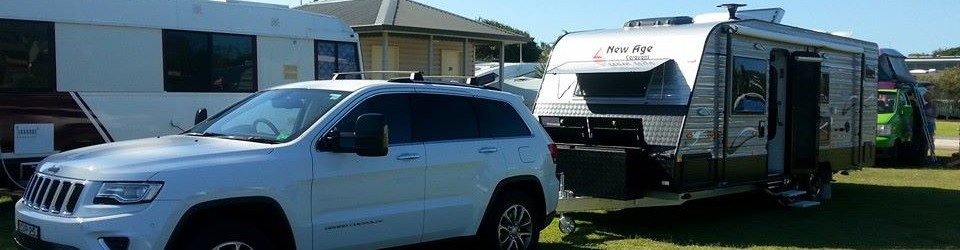
The most common question we get asked by friends and family tends to be around the favourite places we have been to.
To pick an absolute favourite is difficult because so many factors are involved. While some locations are stunningly beautiful, others are filled with great experiences or great people. Often “your” assessment of a place is about your personal experience there and a variety of things influence this, starting from something as basic as where you are staying! Beautiful views from the caravan windows can enhance enjoyment of a place that a view of the amenities block simply can’t match! Sunshine and swimming weather changes your perspective on a place that’s may be rainy and cold at other times of the year (or sometimes within the same week – thanks Wilsons Prom!). Meeting great people and sharing some laughter and good times can make even a dodgy place great! The kids being excited to explore nature creates a different experience and memory from kids who have to be coaxed each step of the way.
There are highlights of course (read back over the last ten blogs if you need to know exactly what they are!) and lowlights (as I am a glass half full kind of person these are not really in the blogs but happy to share when the glass is “half full” of beer!). One thing is for certain for anyone who is wondering – this is a beautiful country we have here, and the highlights and positives heavily outweigh any negatives!
One of the highlights for the trip was always going to be the visit to Uluru. Denver had learnt about Uluru and Kata Tjunta already at school and in many ways his insistence on Uluru being the “Heart Of Australia” created an appropriate geographic and visual representation, especially at sunset and sunrise as the deep red colours of the rock pulse with every minute that passes.
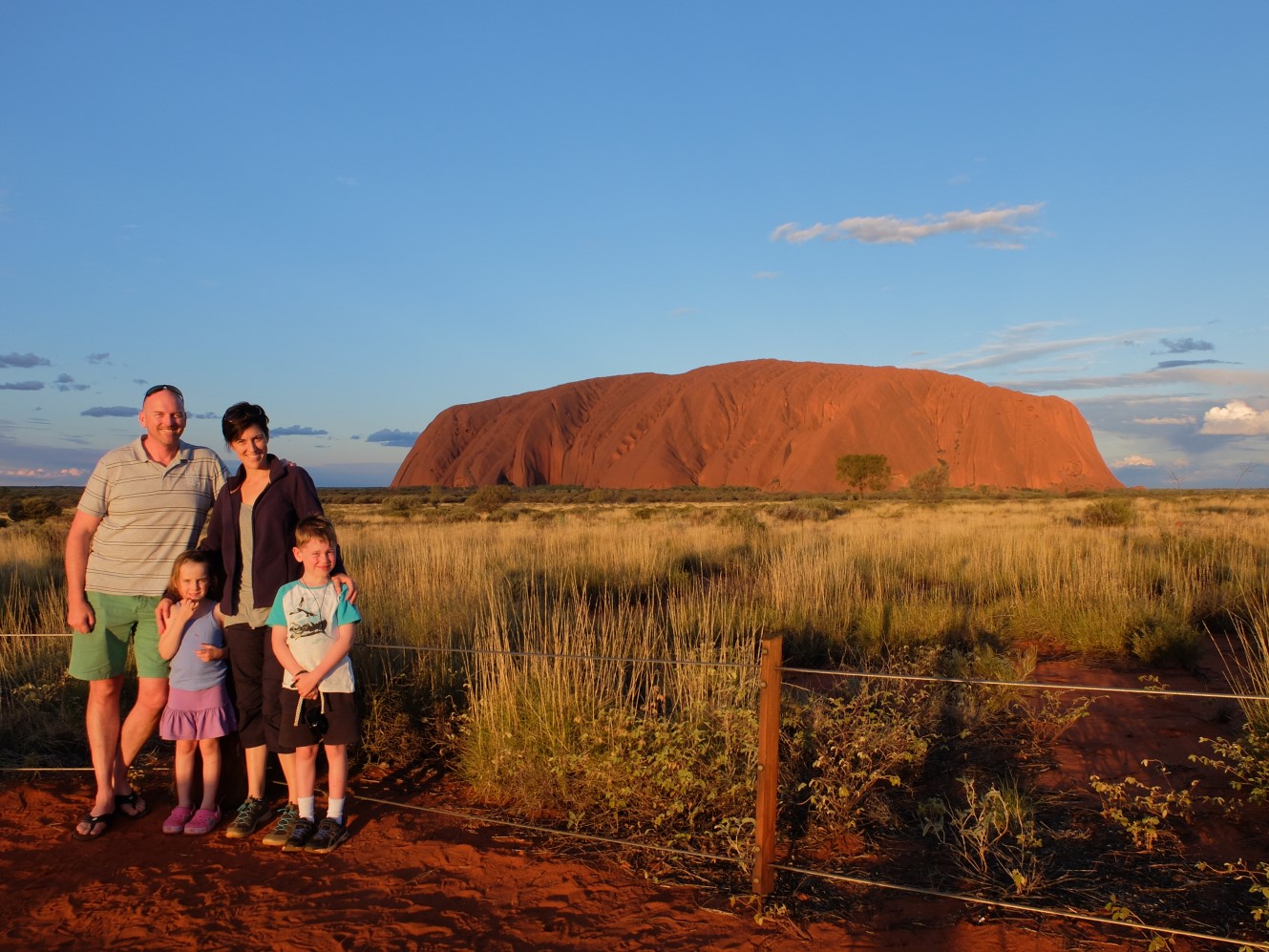
Family photo, finally broke out the tripod!
On the way we pass the lookout for Mt Conner, also known as “Fool-uru”, as it’s fooled many a tourist into thinking it’s one of Australia’s most recognisable icons. Certainly from the highway, the way it rises from the level land around it, does make you pause and do a double take.
Seeing Mt Conner leaves me pondering one of the great questions I am yet to answer in life – what determines that fine line between success and failure, popularity or obscurity? Although shaped quite differently from Uluru and on private land, Mt Conner is impressive and beautiful and yet sits virtually unvisited and unheralded on its own, just 100 off kilometres down the road from its more illustrious “cousin”. It’s like visiting two pubs in the same street but where one is popular and filled with people on any given night the other can be virtually empty. Of course there are many factors determining this, but popularity then drives ongoing popularity. Go into any shop or restaurant that’s empty and watch as others come in behind you. There must be something in the sociable (or distrustful) nature of humans that makes your presence somehow more appealing to others – it’s one of the reasons why empty restaurants will always look to seat you in the windows, so others can see you and follow your lead.
Passing Mt Conner without even a photo (that’s how fine the line is!), we settled into the township of Yulara, which was created in the 80’s to be the base for all tourism in the Uluru and Kata Tjunta National Park. I remember my Mum telling me she had camped right at the base of Uluru when she first arrived in Australia, but there is no such open camping now, in fact you have to be out of the National Park by 7pm each night!
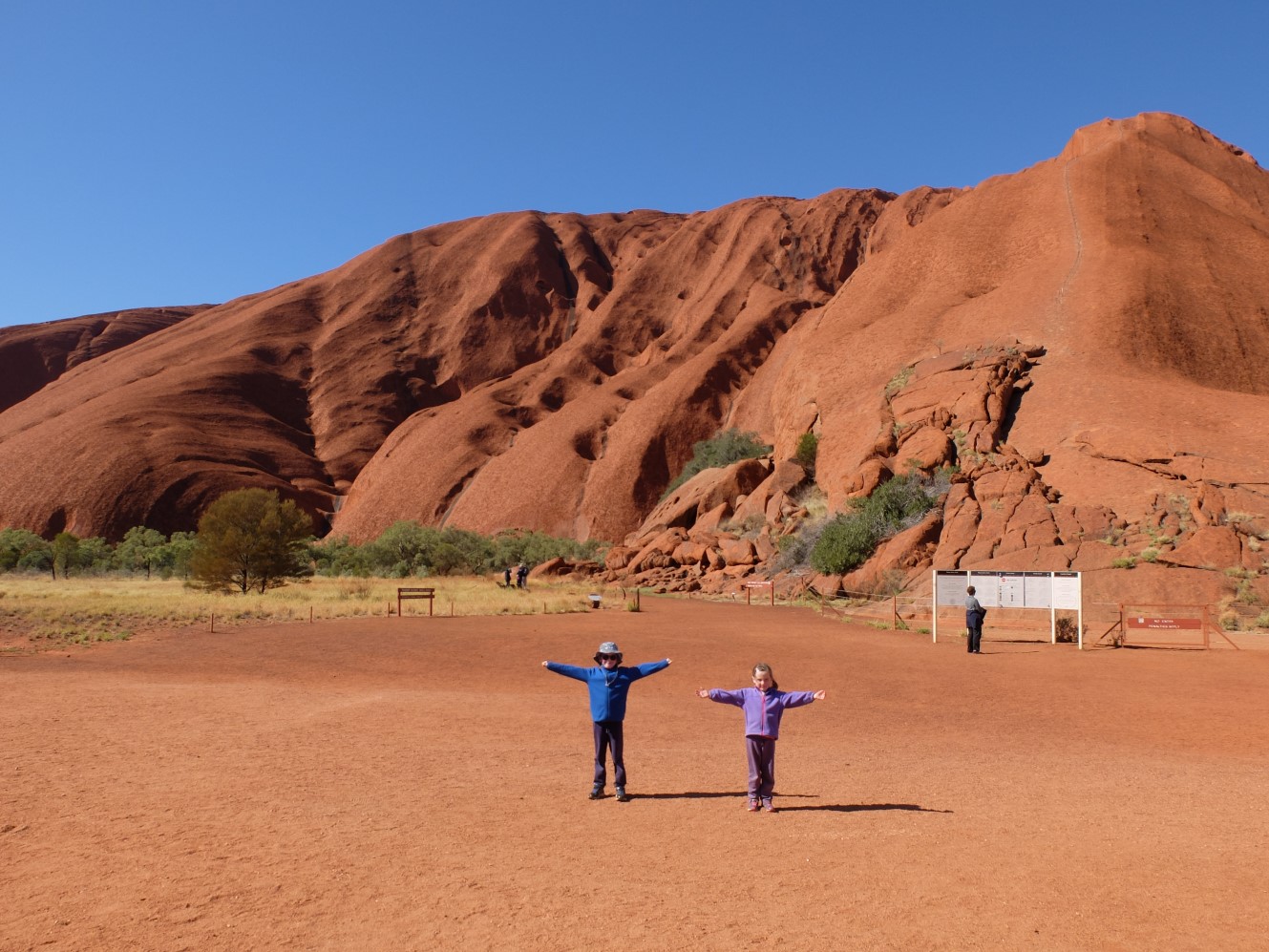
At the base of Uluru – no way you can camp here anymore!
The following morning we took a Ranger tour on the Mala walk around the base of the rock, learning stories about the Anangu people and culture. Uluru plays a significant role in the creation stories of the Aboriginal people and through these stories (the lowest level ones that tourists are allowed to hear anyway) you can see the reverence that was placed on climbing the rock. Only certain elders and leaders were allowed to the top for ceremonies, which is why the Anangu people request that you do not climb. For our visit the climb had been closed anyway, as a Korean tourist very nearly added to the 36 people who have died falling off the rock. He had slipped from the climb the day before we visited, but a number of unsuccessful attempts to get him from the crevice had forced him into an overnight stay. In fact, it wasn’t until later that night that he was rescued, having been up there for nearly two days! You do get the feeling that they weren’t in any hurry to rescue him, no doubt closing the climb and having another example of the dangers involved assists with the parks goal of stopping the climb altogether!
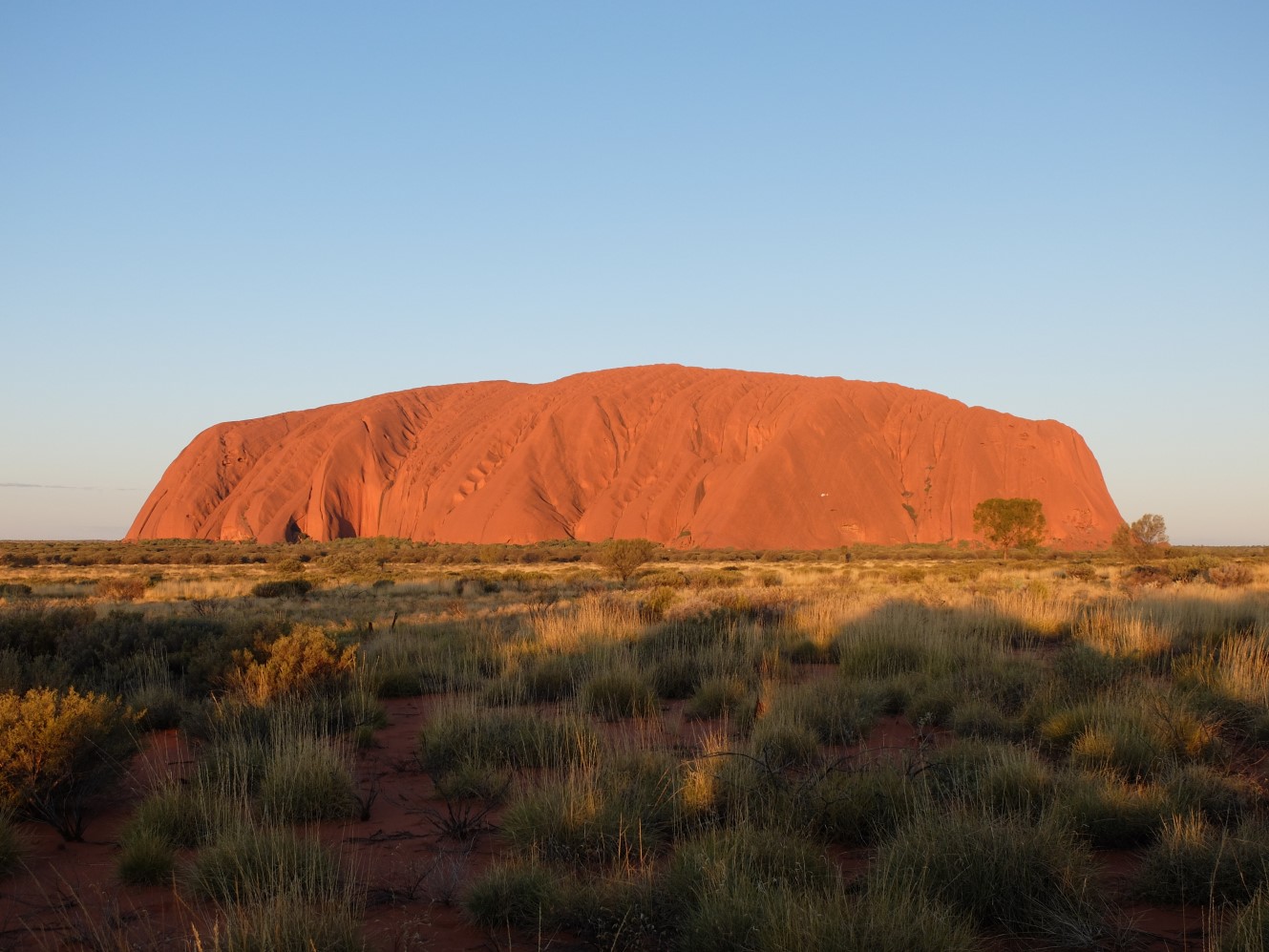
The “Heart Of Australia” – you can just make out the helicopter rescue if you zoom in!
Returning to Yulara we had arranged to take part in a “dot painting” workshop that the centre runs. With traditional women sharing stories and the significance and meaning of certain symbols we all created artworks that symbolised our journeys to date. As you immersed yourself in concentration, trying to construct a dot painting masterpiece, you really had to focus your thoughts and energy on what you were doing. As we painted, the lady on our table explained to us the concept of mindfulness, which has its roots in Buddhist meditation. Barbara explained to us that mindfulness is the focus of one’s attention on the emotions, thoughts and sensations occurring in the present moment rather than worrying about what has come before or what may come after. Barbara was in fact presenting seminars on mindfulness around the country as they travelled and had the next one in Alice Springs in just a few weeks’ time. At the end of the workshop when everyone had to explain what their paintings symbolised, Denver and April were the only children from the group who got up and explained what they had painted, so maybe that sociable desire to follow others starts at a later age!

Denver explaining his dot painting to the group!
The following day the Dalai Lama was in town to give a “community address.” There were a limited number of tickets and people had come from all over the country to see His Holiness in person in such a significant Australian location. We enjoyed amazing music by Tenzin Choegyal and some street performances by local artists before His Holiness the 14th Dalai Lama spoke in his quiet and humorous way about acceptance and being kinder to one another. The Dalai Lama is a funny man, although his humour sometimes borders political incorrectness (which in many ways makes it even more amusing), his gentle tone and messages are inspirational and make you want to better yourself and contribute more to the world around you.
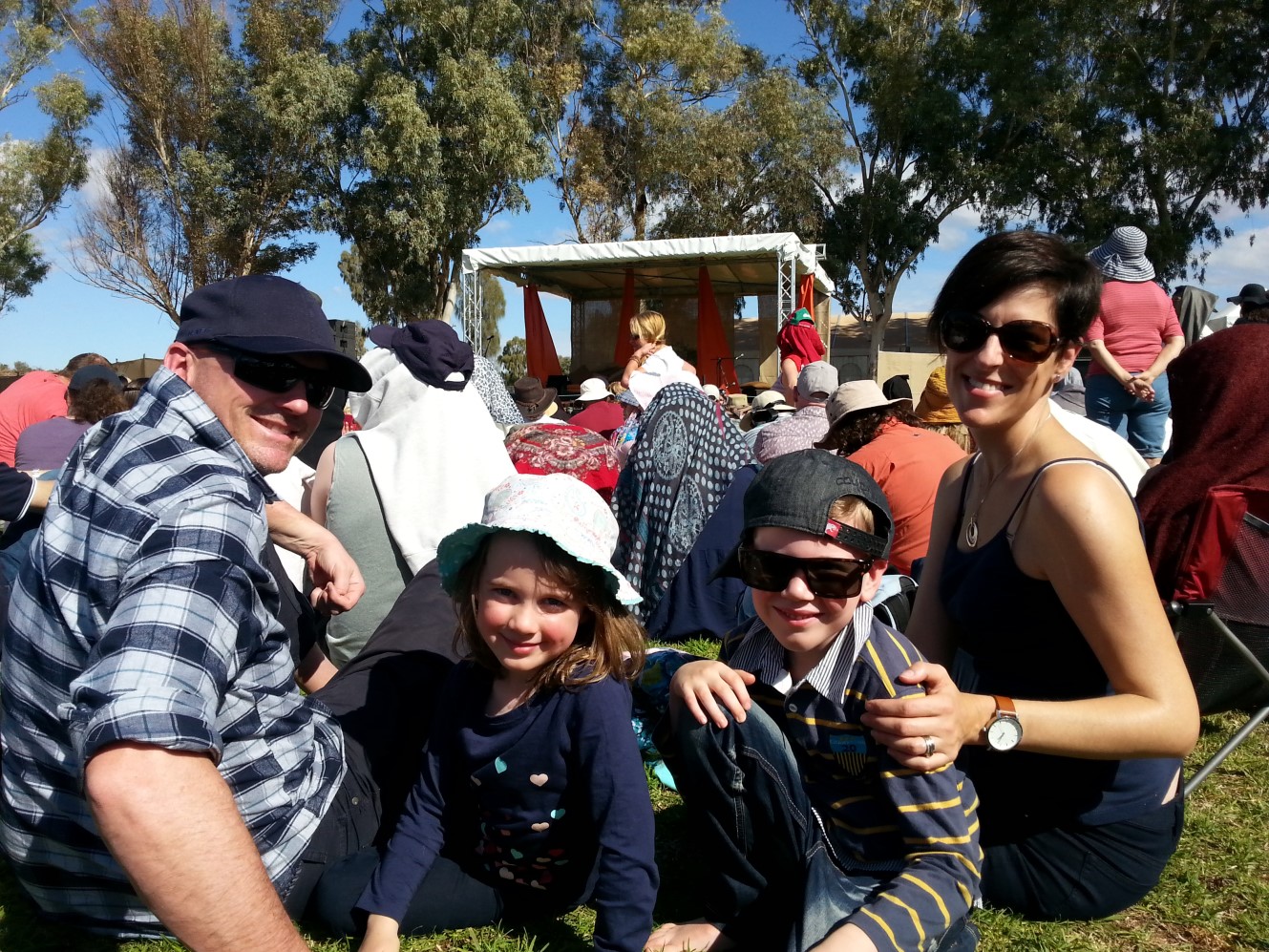
Dressed up for the Dalai Lama, wish someone had read the weather forecast!
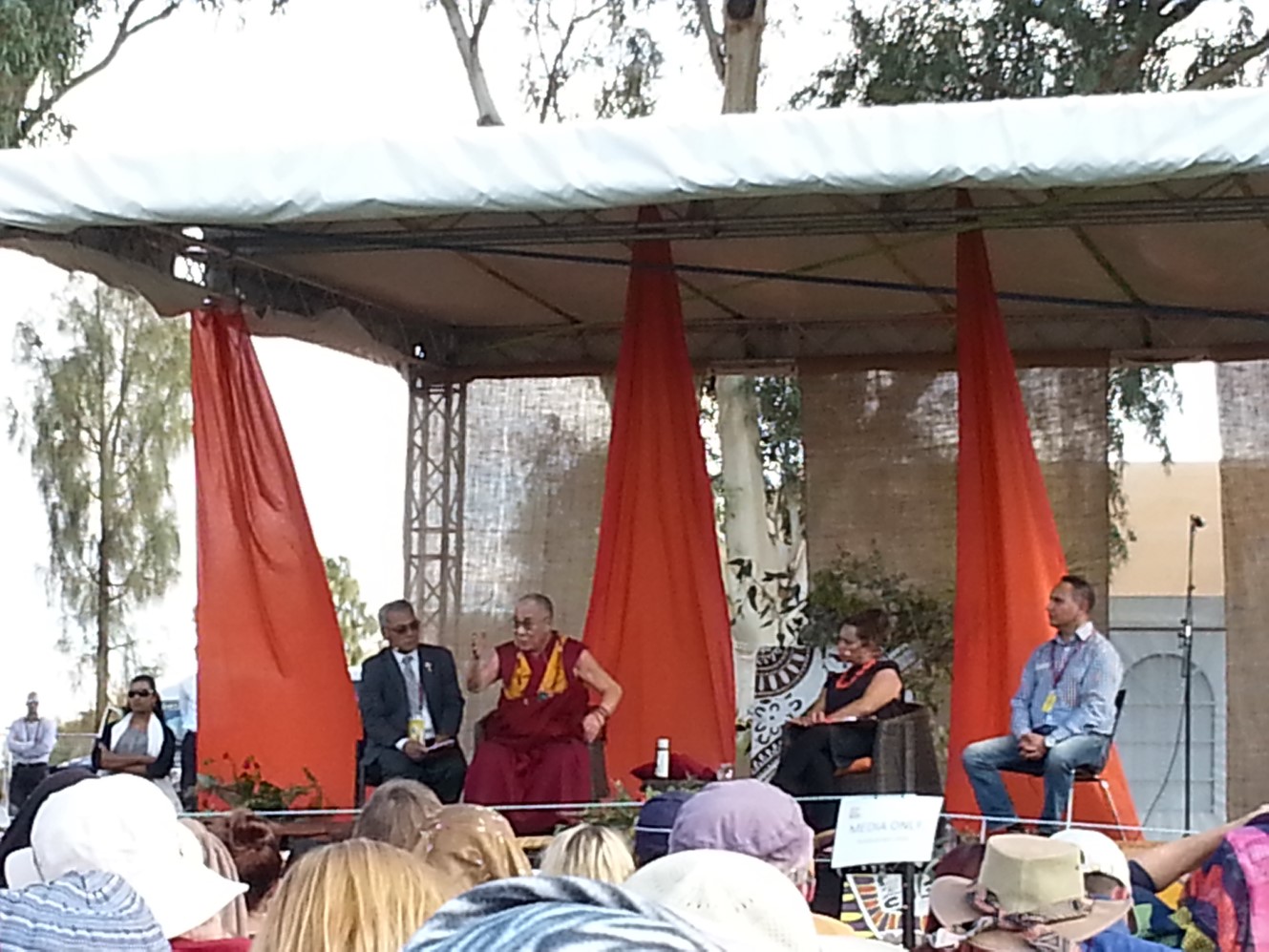
His Holiness the 14th Dalai Lama
After connecting with our spirituality for a couple of days it was time to get back to the physical side and there was no better way to do that than a couple of hikes in and around Kata Tjunta. Kata Tjunta compromises of 36 steep sided domes of conglomerate rock (formed by lots of smaller rocks under intense pressure) and its name is Aboriginal for “many heads.” While many Australians refer to the area by the highest of the domes (Mt Olga or “The Olgas”) the area has officially had dual names since the 90’s when the Aboriginal name for the domes was adopted. Walking through the Valley of the Winds you get some appreciation for the size and beauty of this natural formation. Everywhere you are surrounded by beautiful rock that changes each time a cloud passes overhead and lends itself to beautiful sunsets. A walk into the Walpa Gorge was well worth the extra encouragement needed and allowed us some spectacular photos among the steep gorge walls and beautiful fauna that’s protected by the Gorge itself. Photos from in and amongst Kata Tjunta don’t really do it justice as you can’t really capture the scale of these enormous conglomerate structures until you get further away, but it’s a beautiful place with very enjoyable walks.
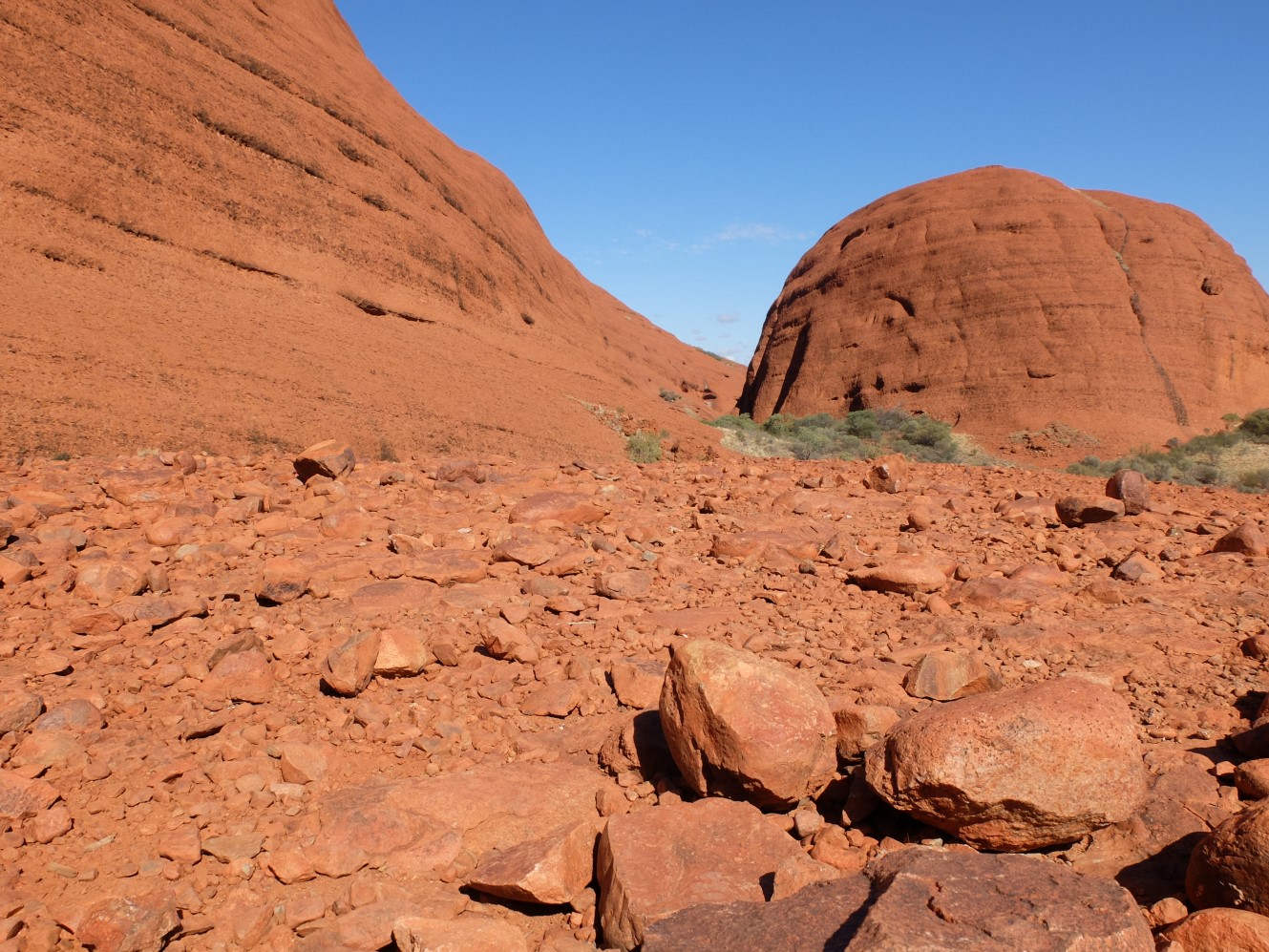
Kata Tjunta – Valley of the Winds walk, it wasn’t too windy!
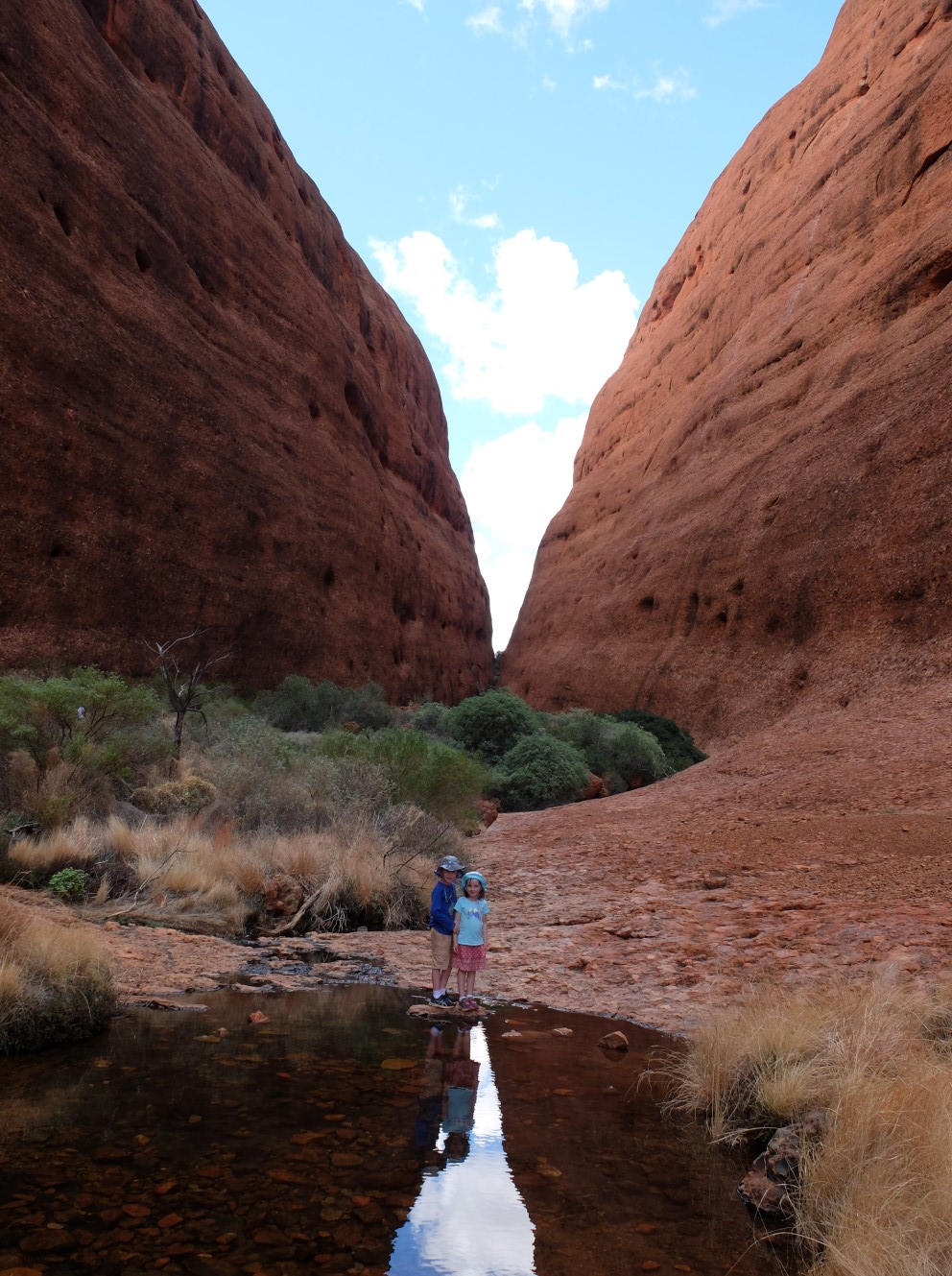
Walpa Gorge, first its just rocks and then…
Sunrise and sunset viewings are highlights of the Uluru and Kata Tjunta National Park and we spent hours marvelling at the changing appearance of both Uluru and Kata Tjunta during these phases of the day. I know all photographers love both of these times as the “light” makes for some great images and although I don’t consider myself to be anything other than an amateur photographer it’s easy to see why these times of day are so revered. Whilst not being the most kid friendly times the effort was well worth it! All we have to do now is select from the hundreds of images taken seemingly just moments apart as the colours of the rock ebbed and flowed into darkness and then into light again as the sun rose. Although we are in the age of digital I am sure many rolls of film would have been taken in the past from very similar positions, such is the beauty and constantly changing nature of the transition…
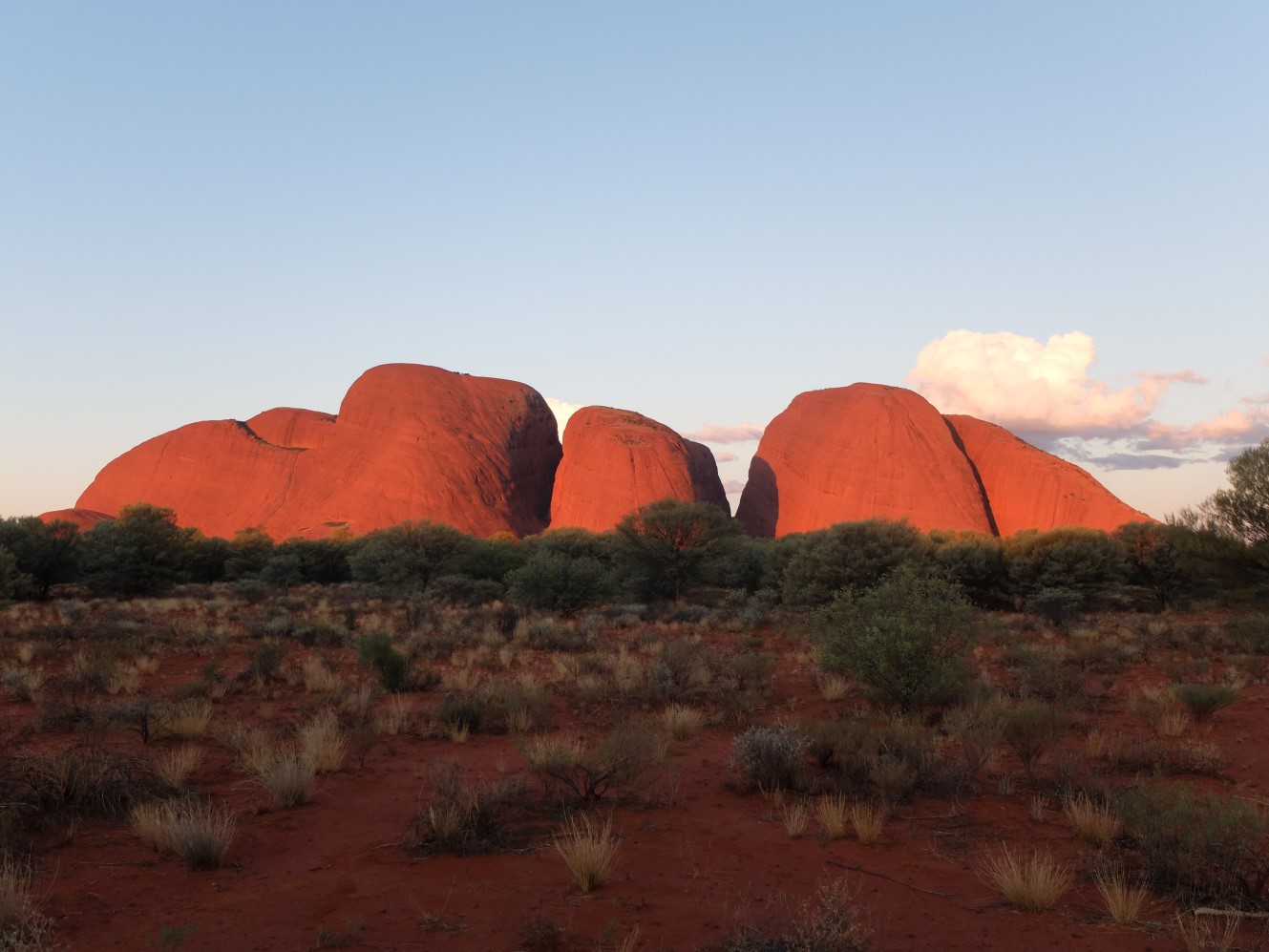
Kata Tjunta at sunset
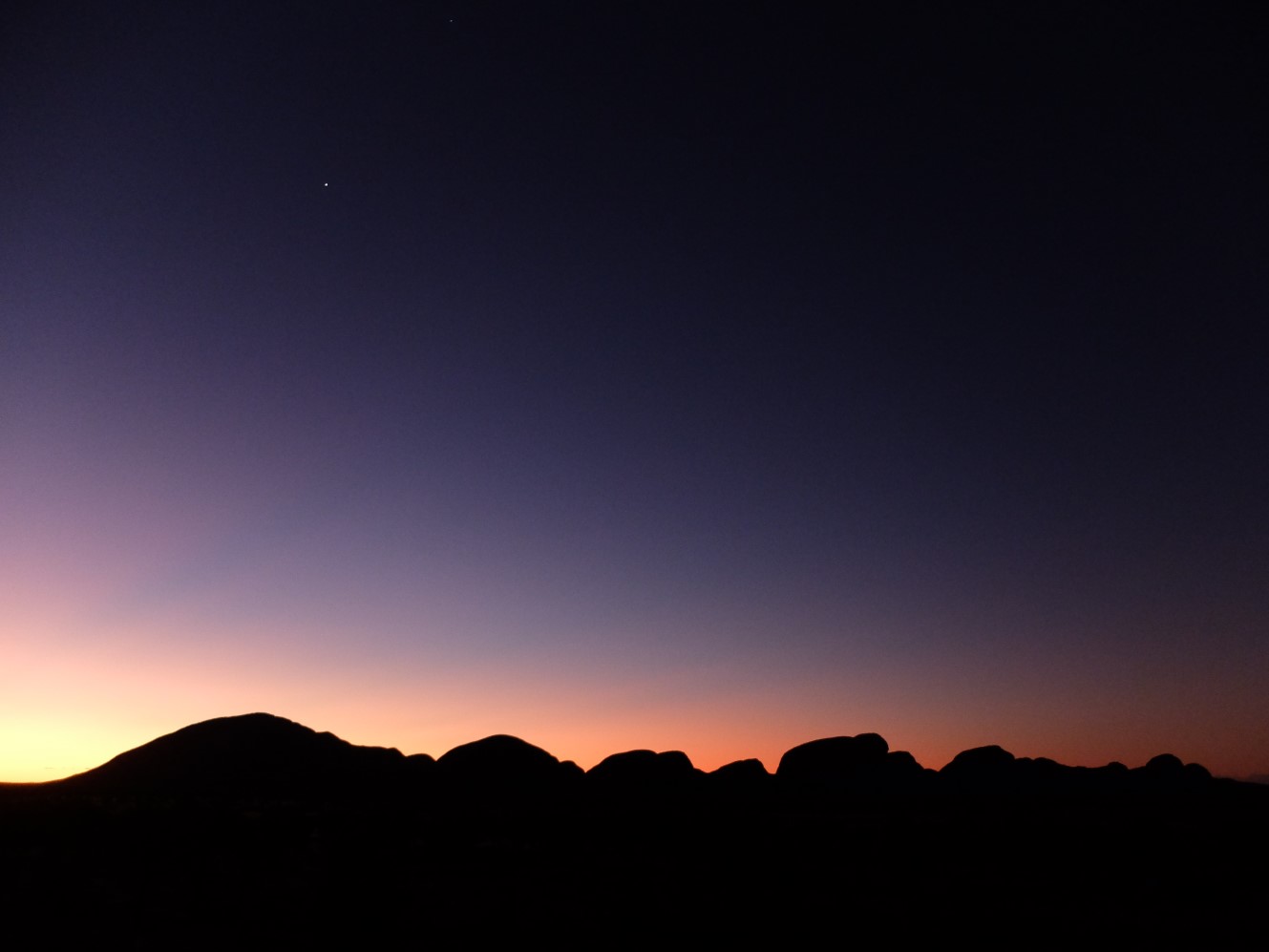
Kata Tjunta from the “other side”, you can really start to see the 36 “heads”
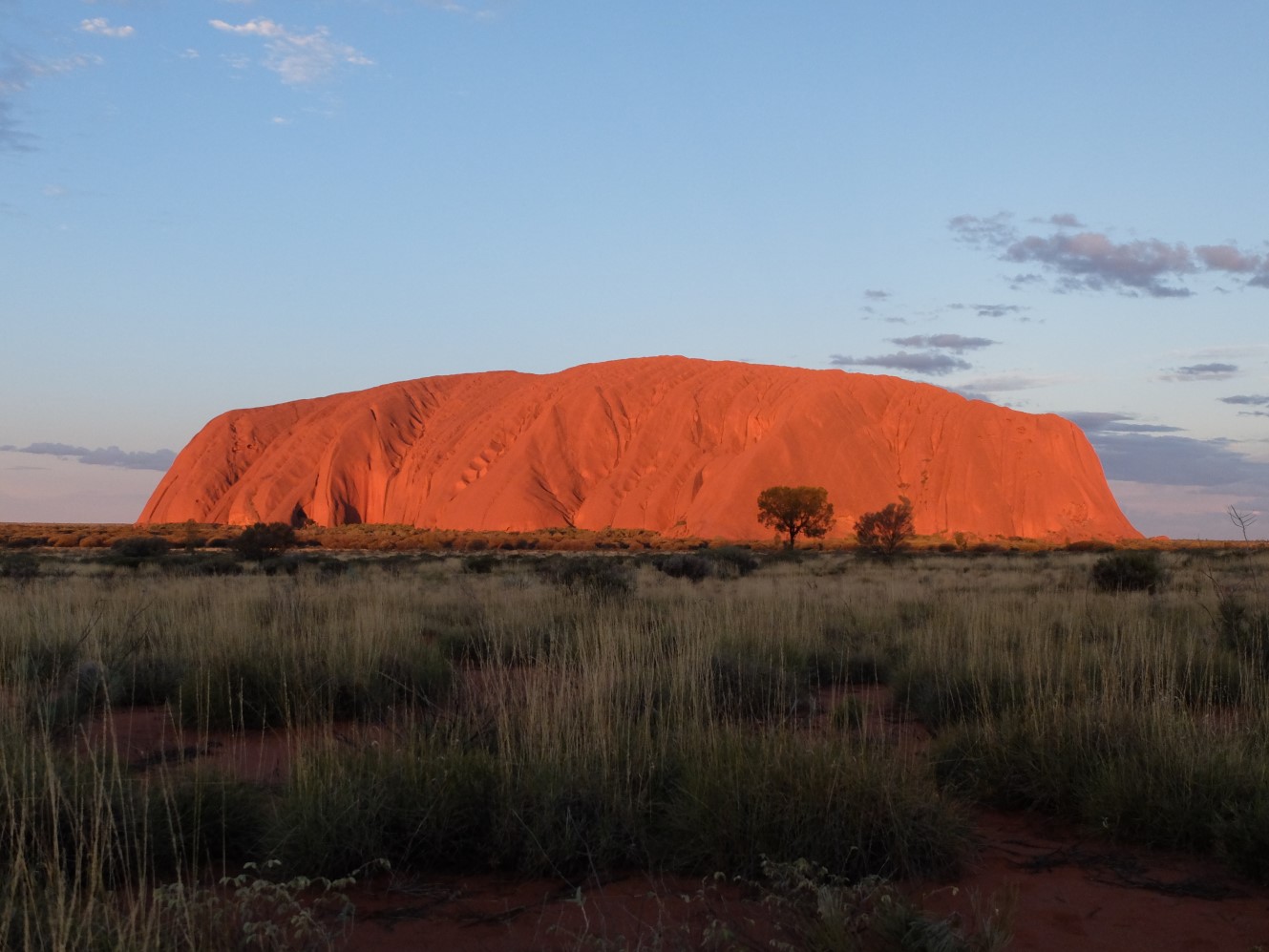
Sunset at Uluru, its hard to select from the hundreds of images taken! PS- thats how it looks, im not clever enough for effects!
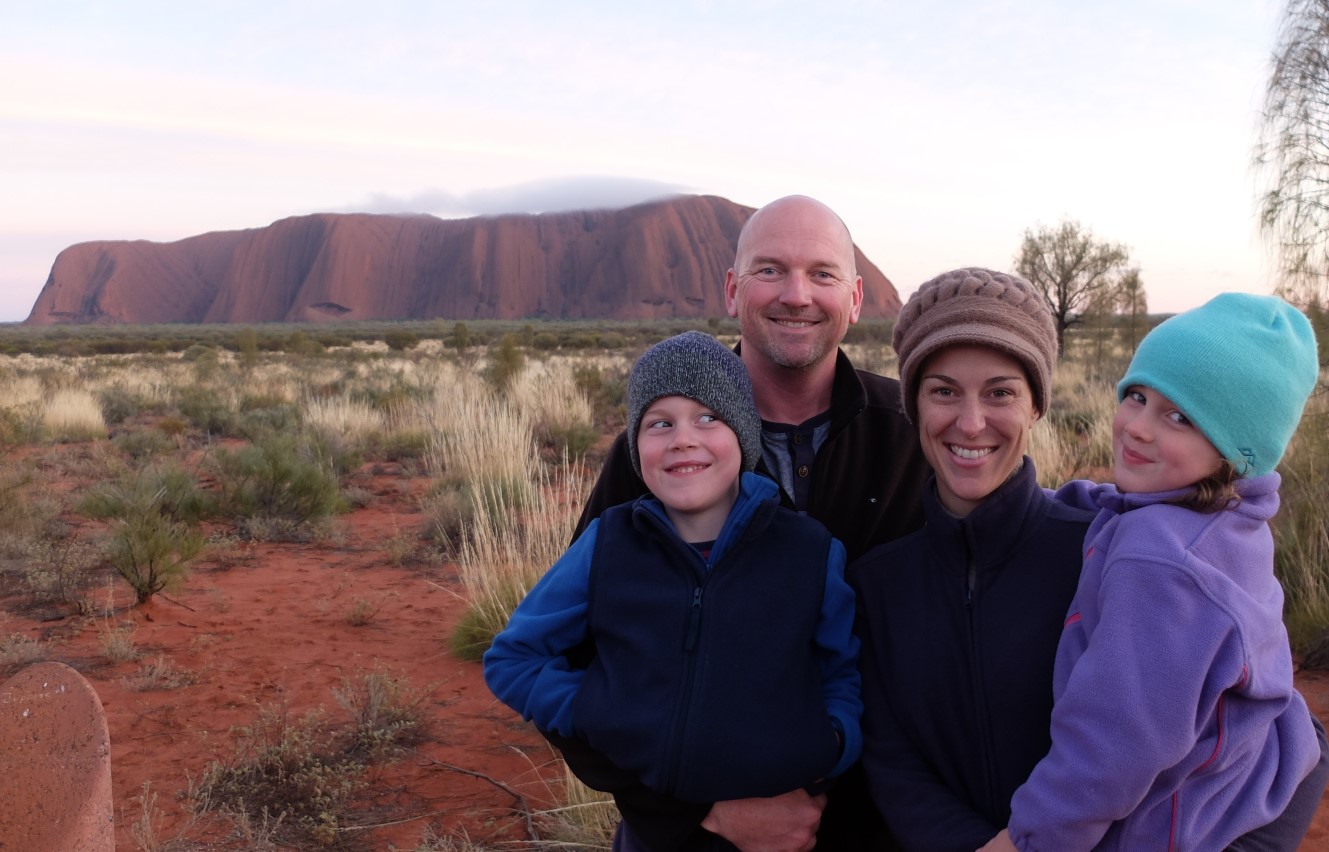
At sunrise! Cold but cheerful!
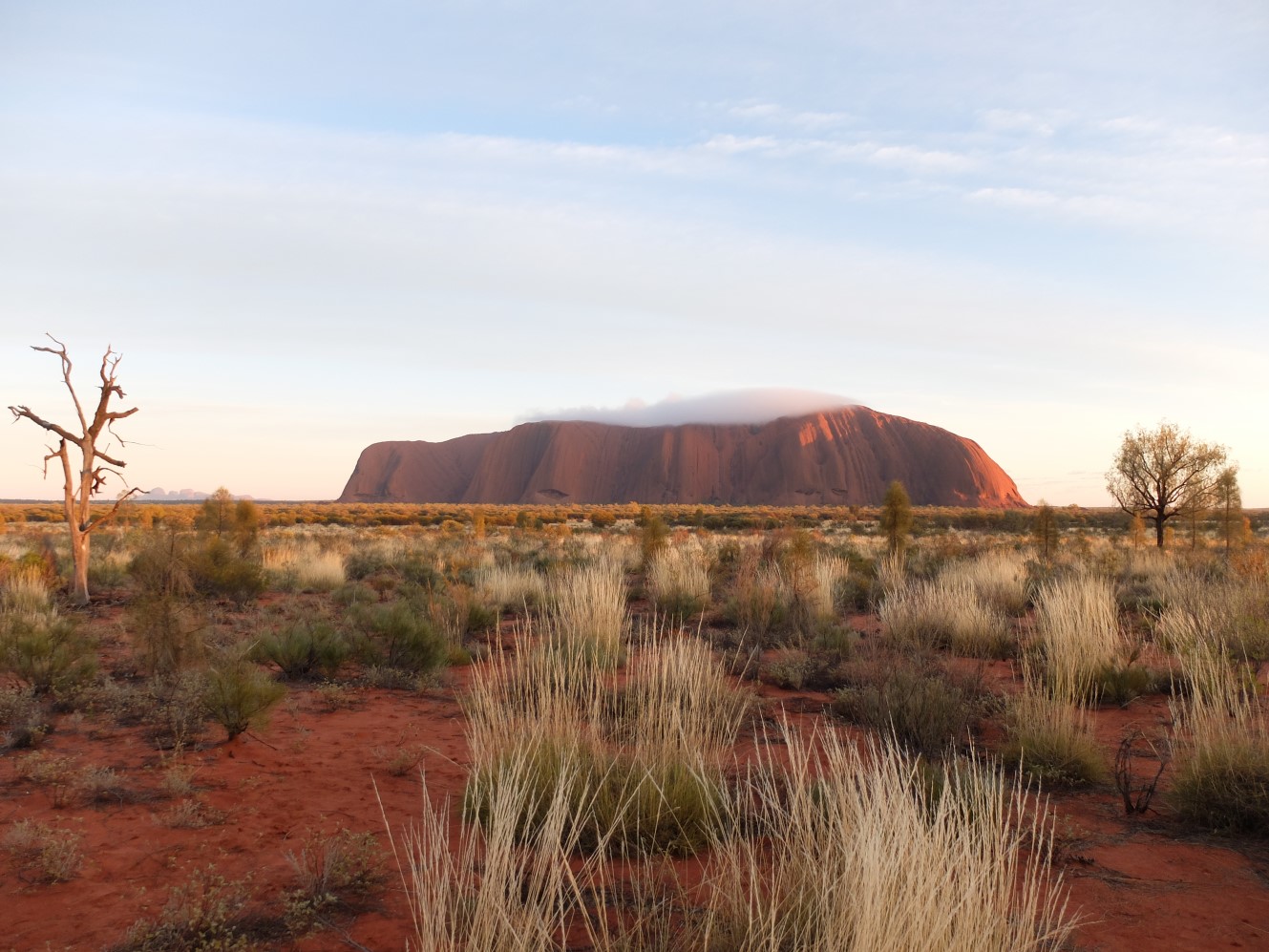
First light on the rock with Kata Tjunta in the background!
The next stop was Kings Canyon where we started our stay with another sunset, although this time a much more civilised one, with drinks and nibbles served by the caravan park from their on-site lookout. While nowhere near as spectacular as the Uluru or Kata Tjunta sunsets the hospitality was most welcome after another day on the road. On the way in we had seen our first “wild” dingo, roaming around one of the rest spots, hunting for scraps. By the end of our stay in Central Australia we had seen quite a few, but none more so than at Kings Canyon where I can even say “a dingo stole my… shoe!” Fortunately he must have worked out that processed rubber is not all that nice and dropped it about 100m away from our caravan. Always on the lookout for an opportunity to grab food or other useful items, Dingo’s are generally not dangerous and it was interesting to see these wild dogs of Australia up close and personal.
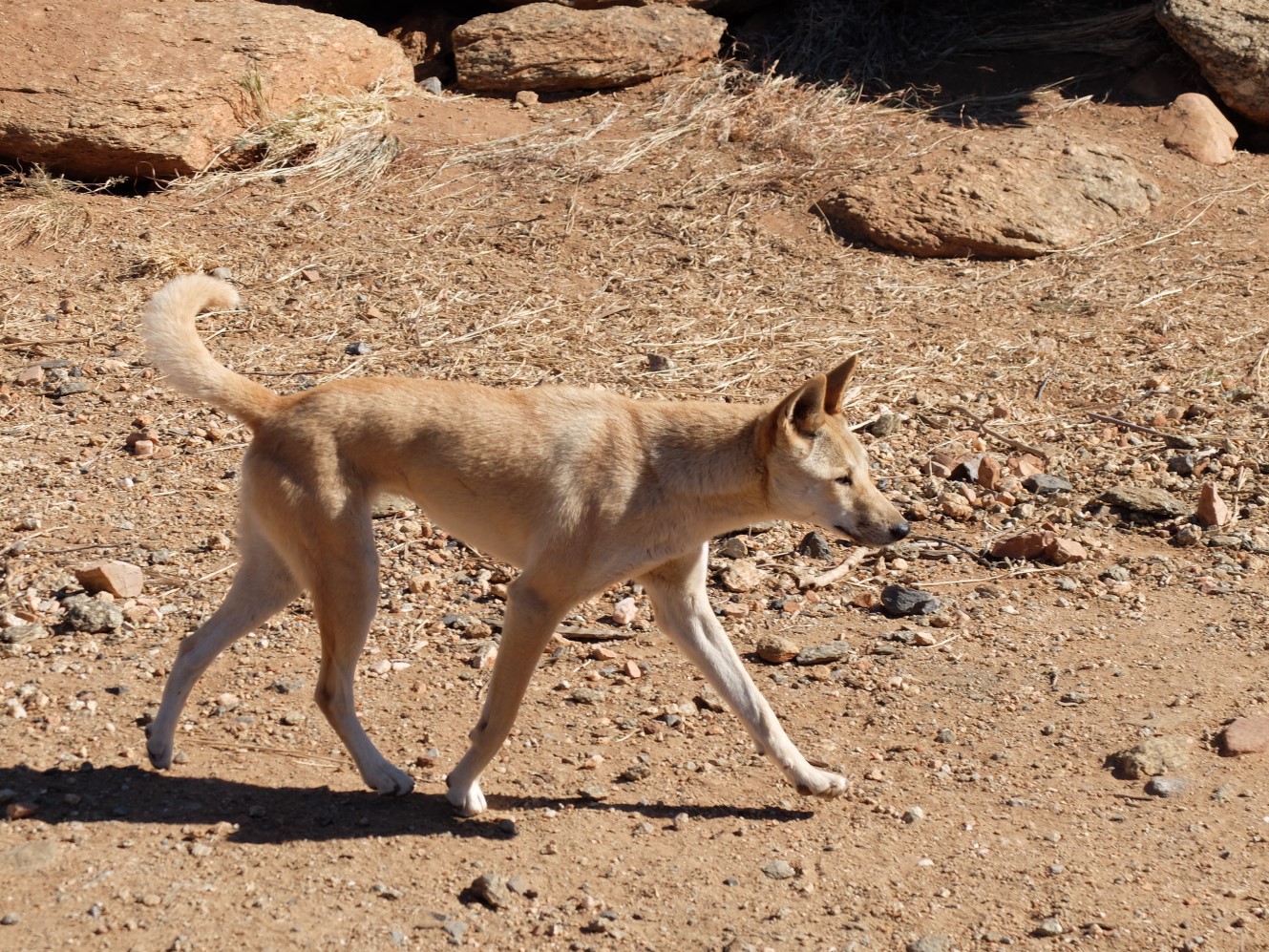
Australia’s wild dog – this one looks pretty healthy, must be all the shoes!
Kings Canyon is famous for the spectacular canyon (the clue is really in the name!) and while you can walk into the canyon floor itself the more spectacular option is the rim walk, which is a 5.5km circuit around the upper rim of the canyon itself. It starts with a pretty serious uphill section, which took a lot of encouragement (in the shape of a lolly snake) to convince the kids it was going to be worth it! Once up the initial climb there is still plenty of scrambling and rock climbing needed to get around the top, but along the way you are rewarded with some amazing views and beautiful rock formations. The part I loved the most is that apart from the odd sign warning you that the edge is near, there isn’t a guide-rail / protective barrier or any other such measure designed to protect you from yourself along the way. No doubt it will change when the first person topples over the side, but for now this walk is a throwback to when common sense ruled and its all the more enjoyable for it!
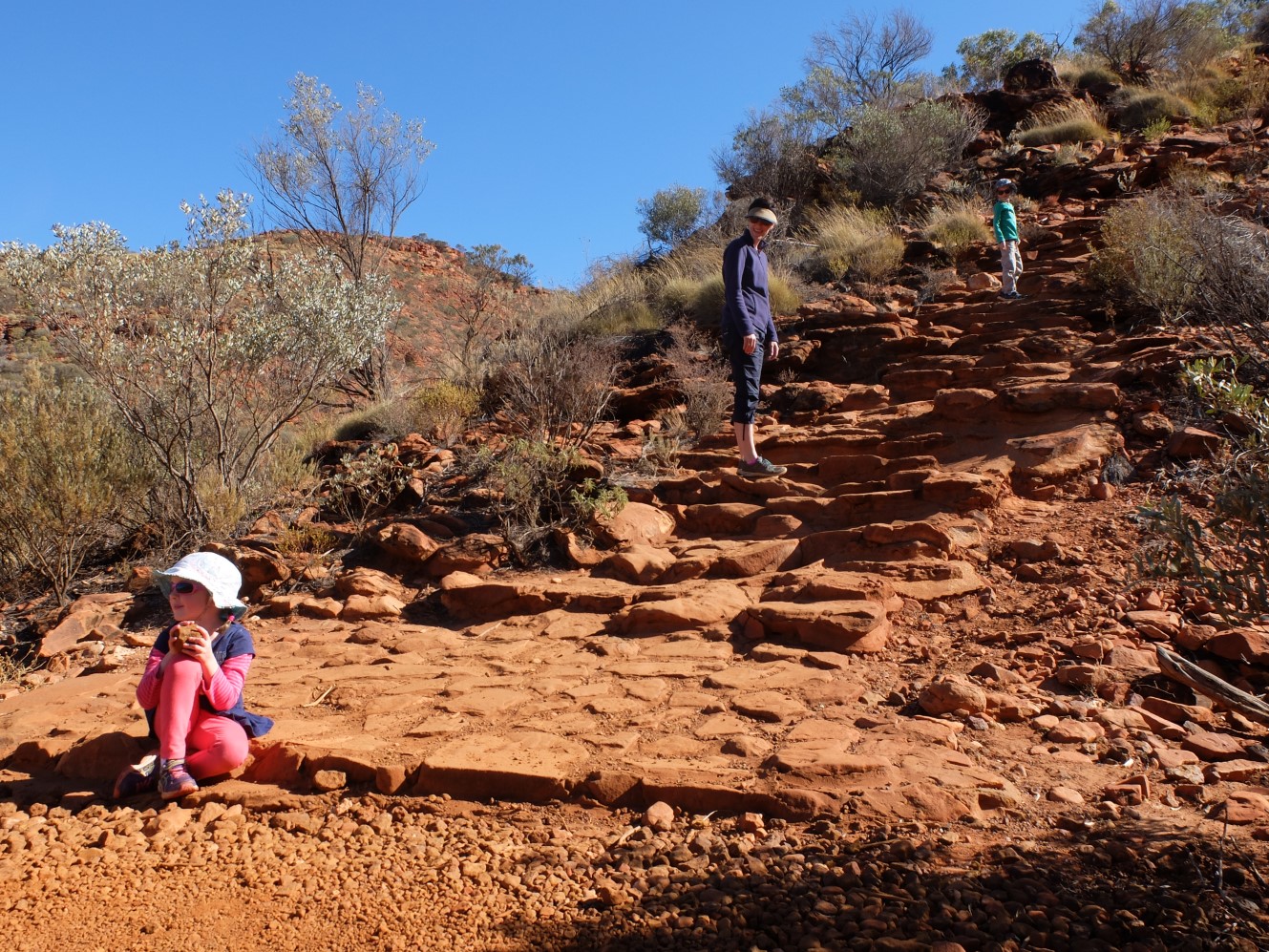
This looks far enough for me (we had only just begun)!
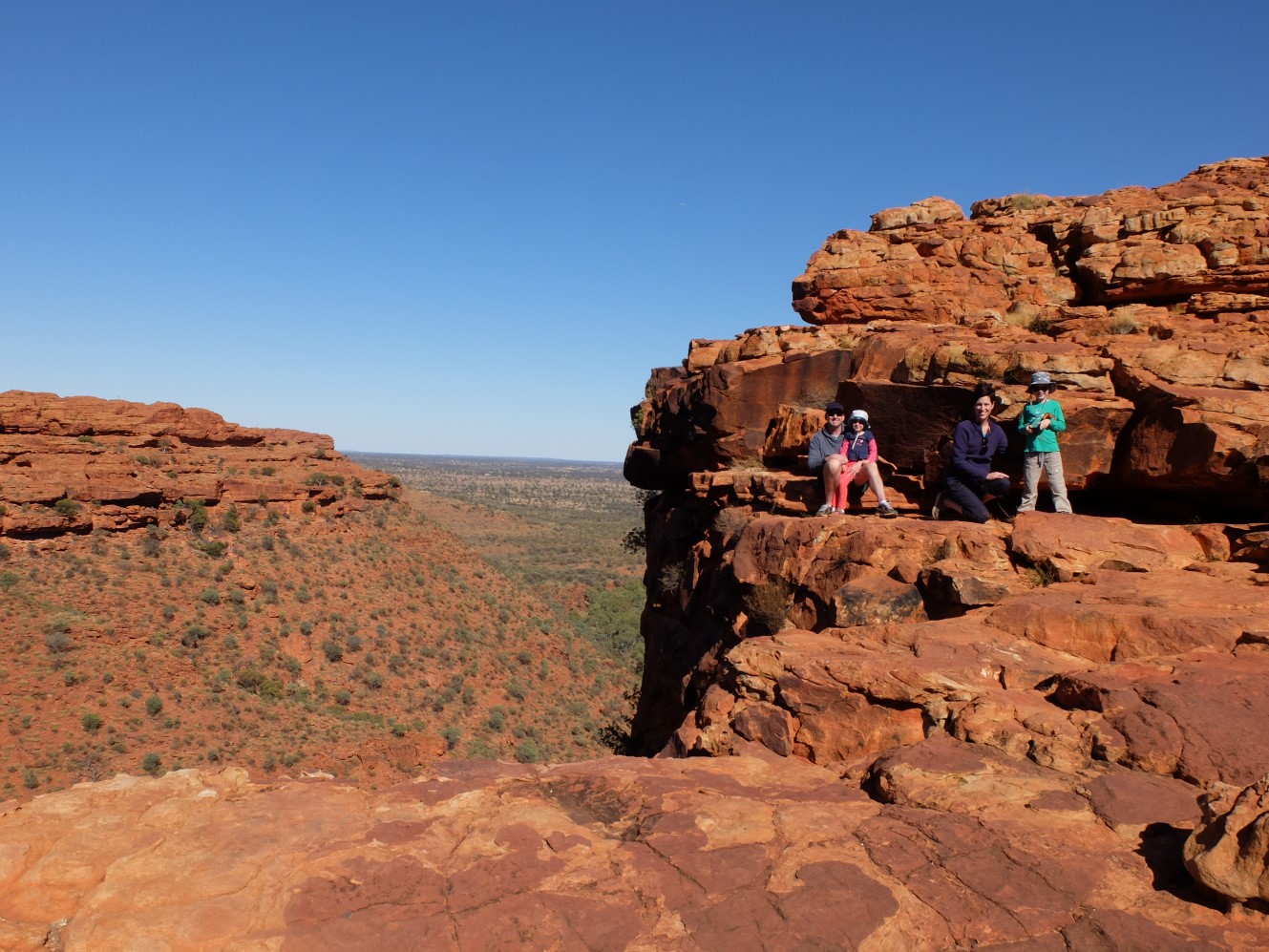
At the top, definitely worth it! No barriers or warning signs!
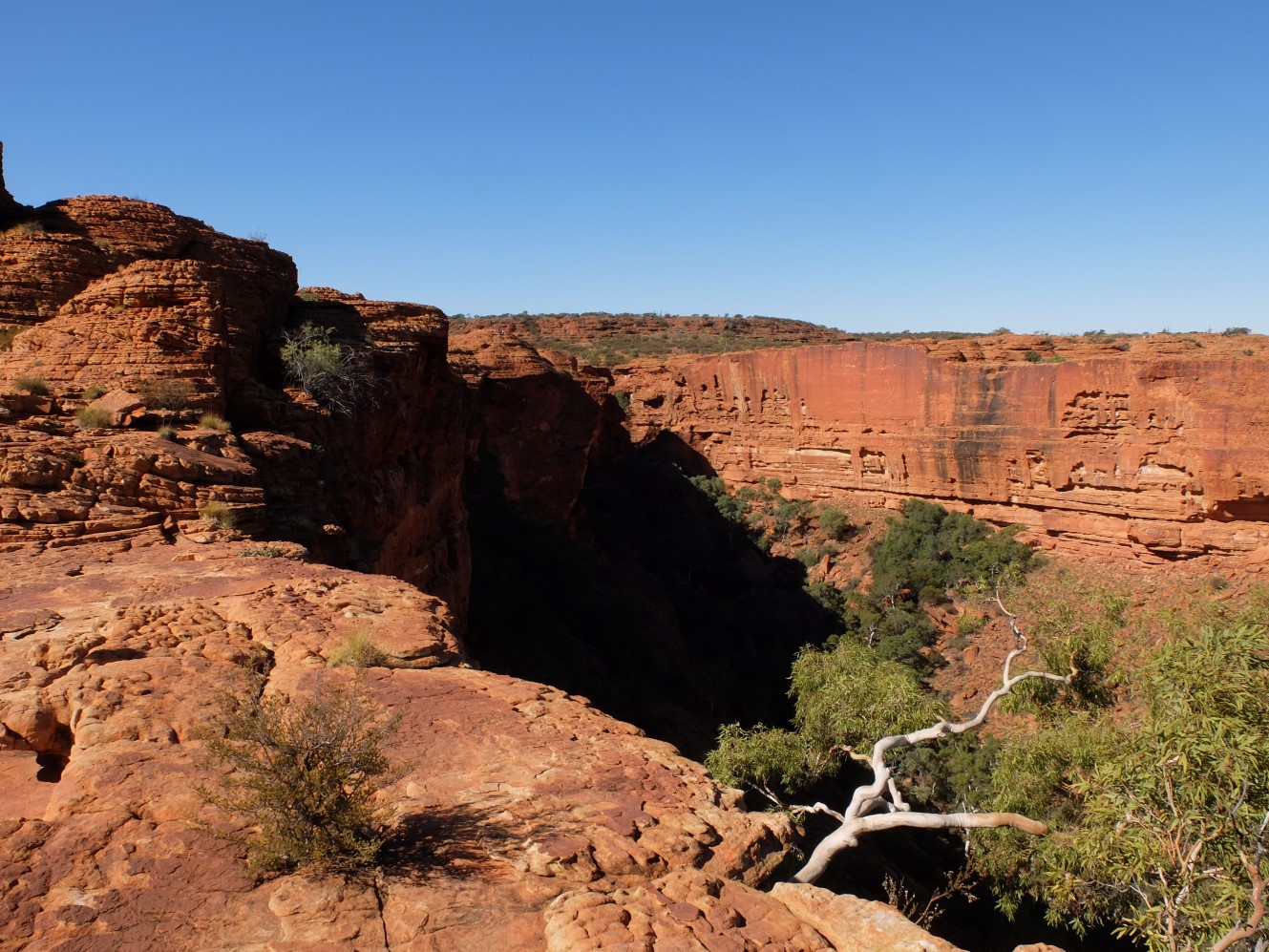
Spectacular Kings Canyon walls
A couple more walks into the floor of the gorge and around the surrounding areas were followed by some more “mindfulness” as we caught up again with Barbara and Tony. Barbara introduced the kids and Hayley to “mandalas” and the afternoon was spent creating some beautiful mandalas whilst relaxing and focusing on the task at hand. Not only are these concentric structures balanced and very visually appealing they are also individual and personal and the kids loved watching their circle creations coming to life on the page. So much did the kids enjoy making the mandalas and spending time with Barbara and Tony that we arranged to meet them again in Alice Springs a few days later.
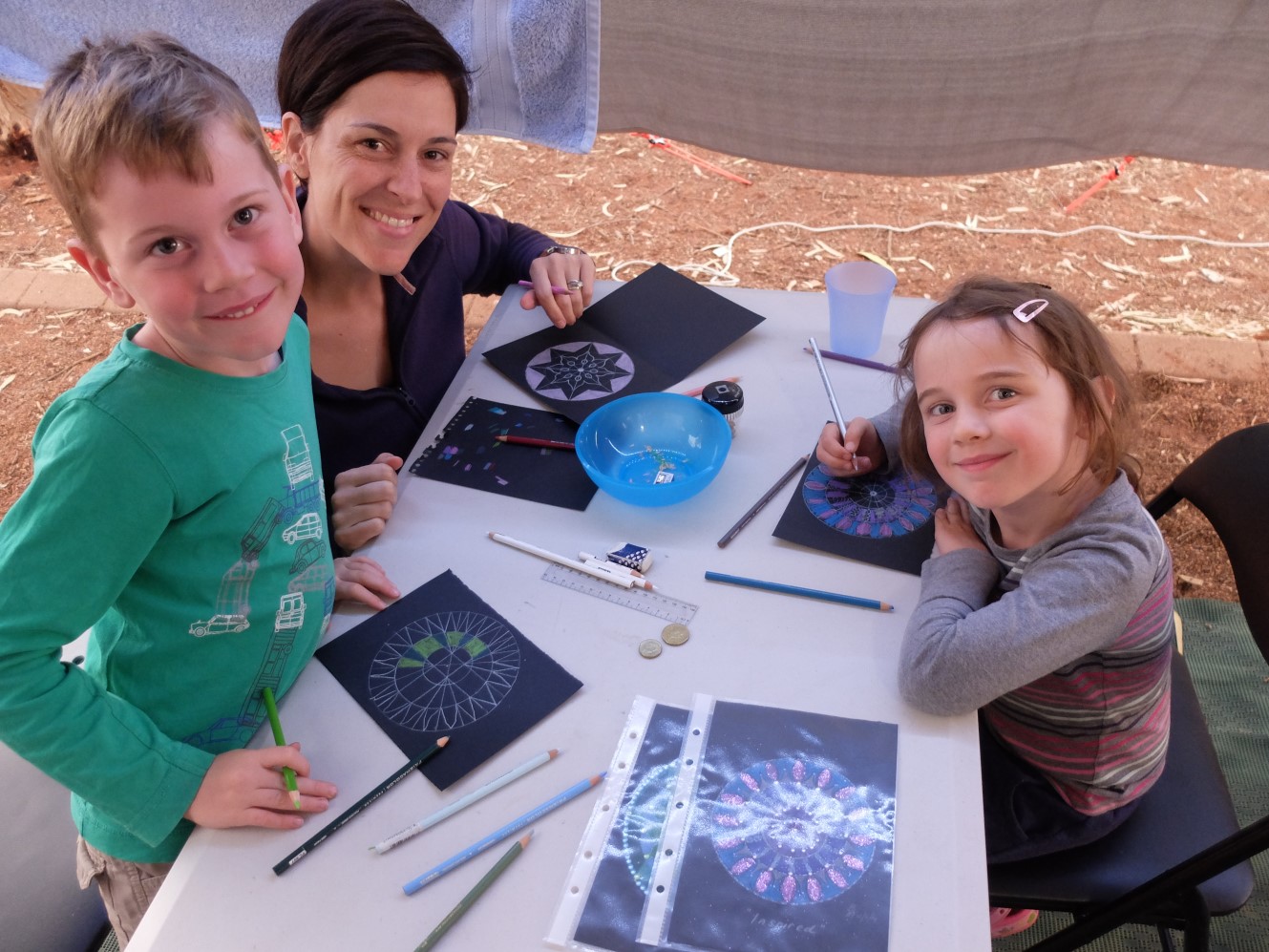
Mandala drawing!
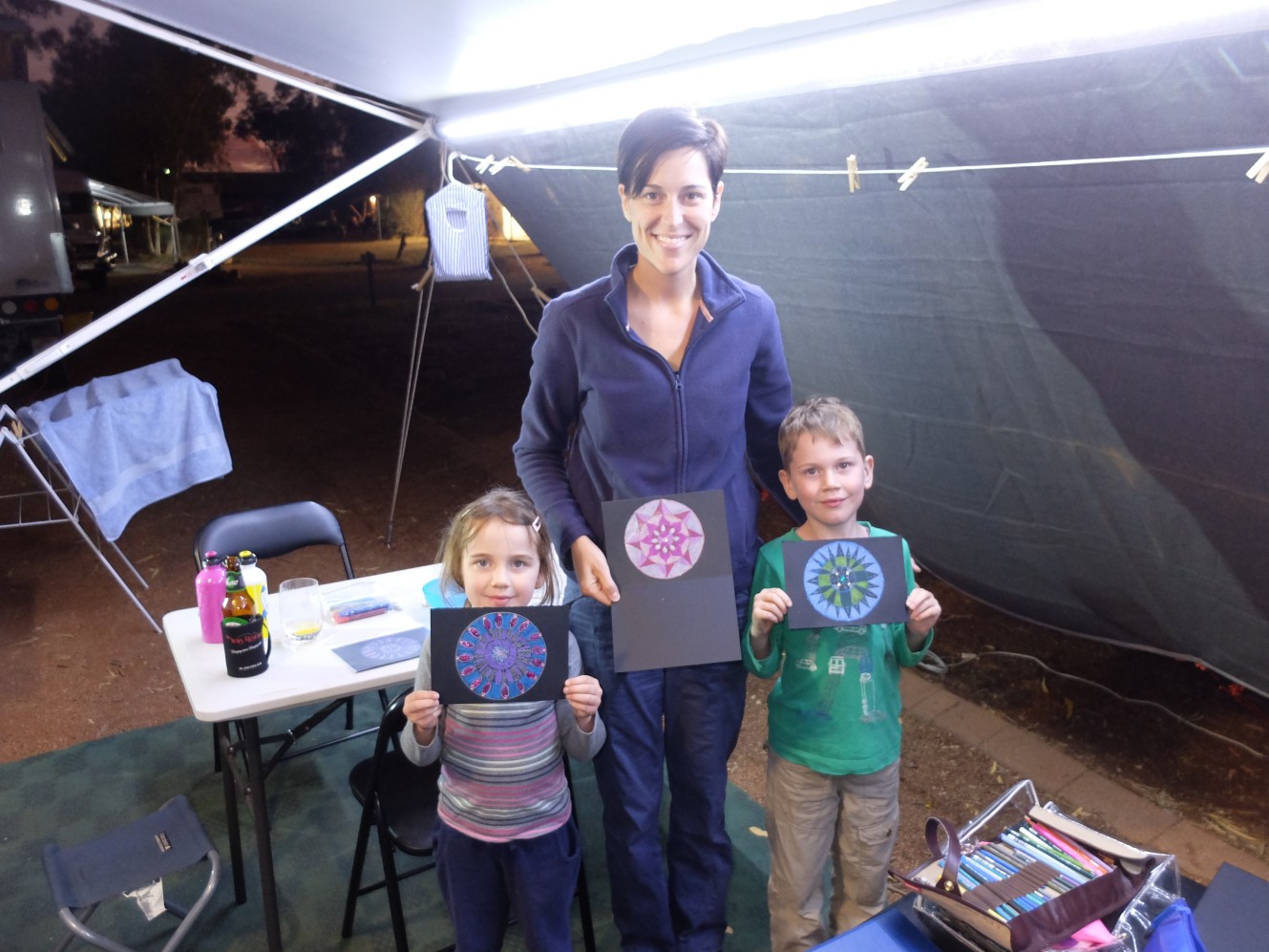
The finished products!
In the end not only did we end up catching up with Barbara and Tony, but Hayley ended up attending Barbara’s two day workshop on mindfulness… While Hayley was on the workshop I took the kids to the Reptile Park, Rainbow Valley and the Alice Springs Desert Park. The Reptile Park was a particular favourite, despite being the smallest wildlife park I have ever visited (the advertising material states if you have a spare hour pop in to say hello!). Despite its size we got to see the amazing Thorny Devils up close, the incredibly large Perentie Goannas (the largest native Goanna in Australia), the weekly feeding for a juvenile saltwater croc named Terry (gruesome but fascinating!) and the highlight of it all was holding a 4m long Olive Python called Popeye!… As soon as April knew we could hold animals (generally Blue Tongue and Frilled Neck Lizards) she was in my ear telling me how much she wanted to hold a snake! In the end she was the first volunteer to have the python wrapped around her (all the other adults in the room looked very reluctant) with Denver and then myself following on from her act of bravery (it’s hard not to when a 4 year old is leading the way!)…
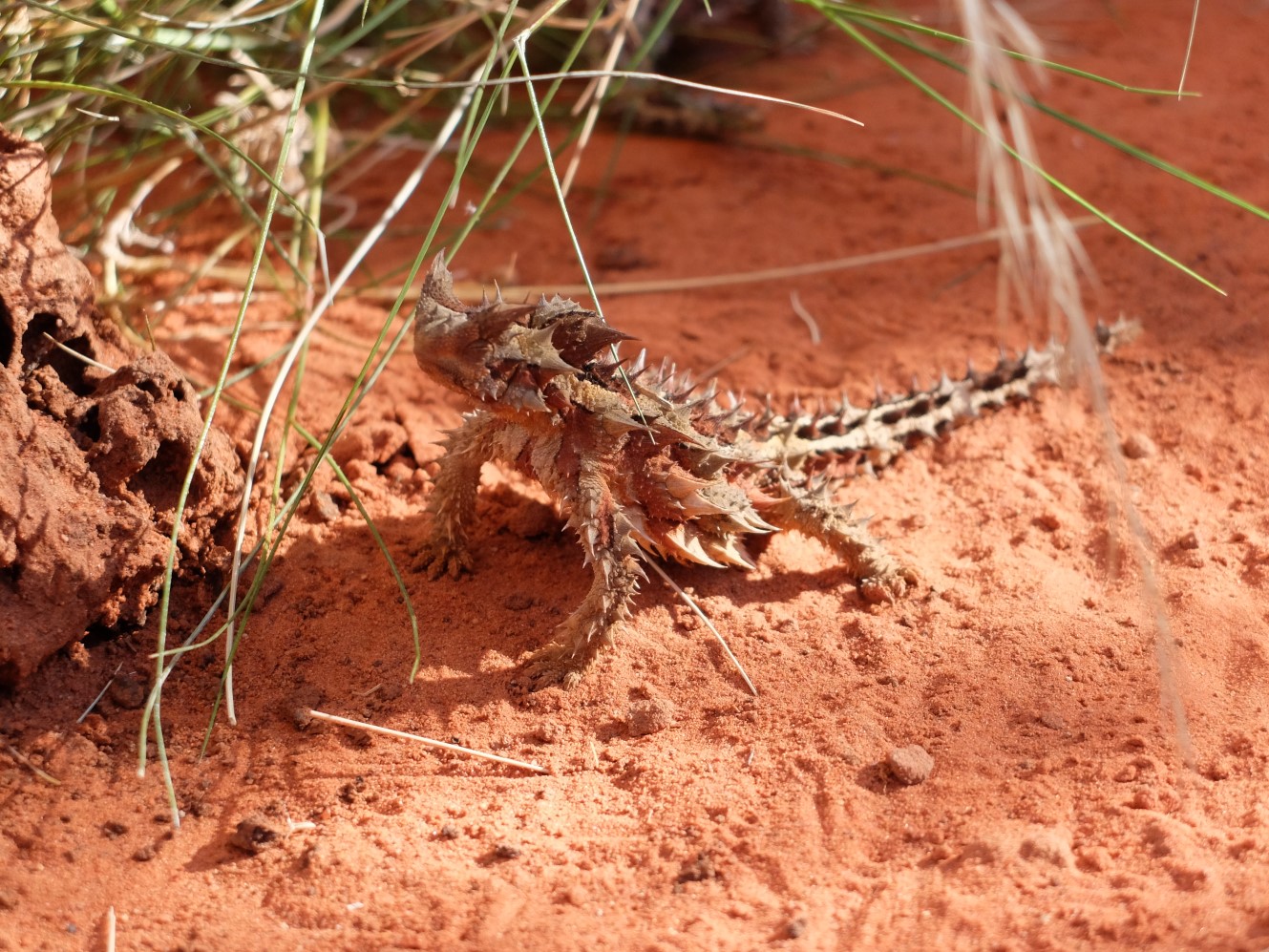
Thorny Devils, they have a amazingly funny walk to try to avoid predators
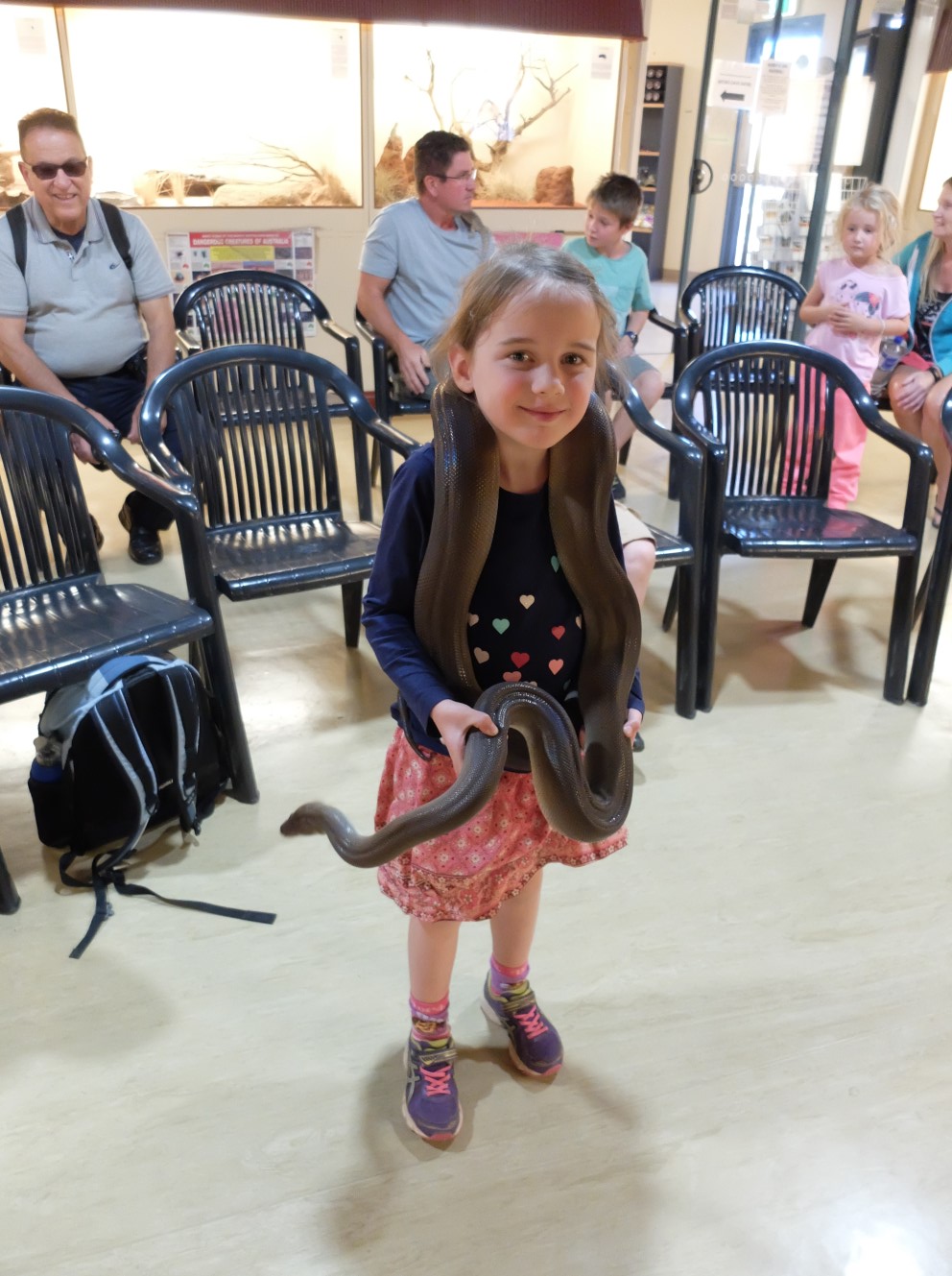
The 4m Olive Python – at this time of year its cold, so it makes it way to the neck and head where its warm!
A visit to Rainbow Valley (sounds like a children’s story location!) for sunset was another spectacular memory card filler. The kids and I enjoyed a walk to Mushroom rock, a picnic dinner and then the sunset on the rocks before heading back to the caravan for the night. It’s a fair way out of town on some unsealed roads (which I’m sure the car is still rattling from), but worth a visit if you have the time. You can even camp out there (but with no such plan in place and no phone reception I didn’t think this would be appreciated much by Hayley!).
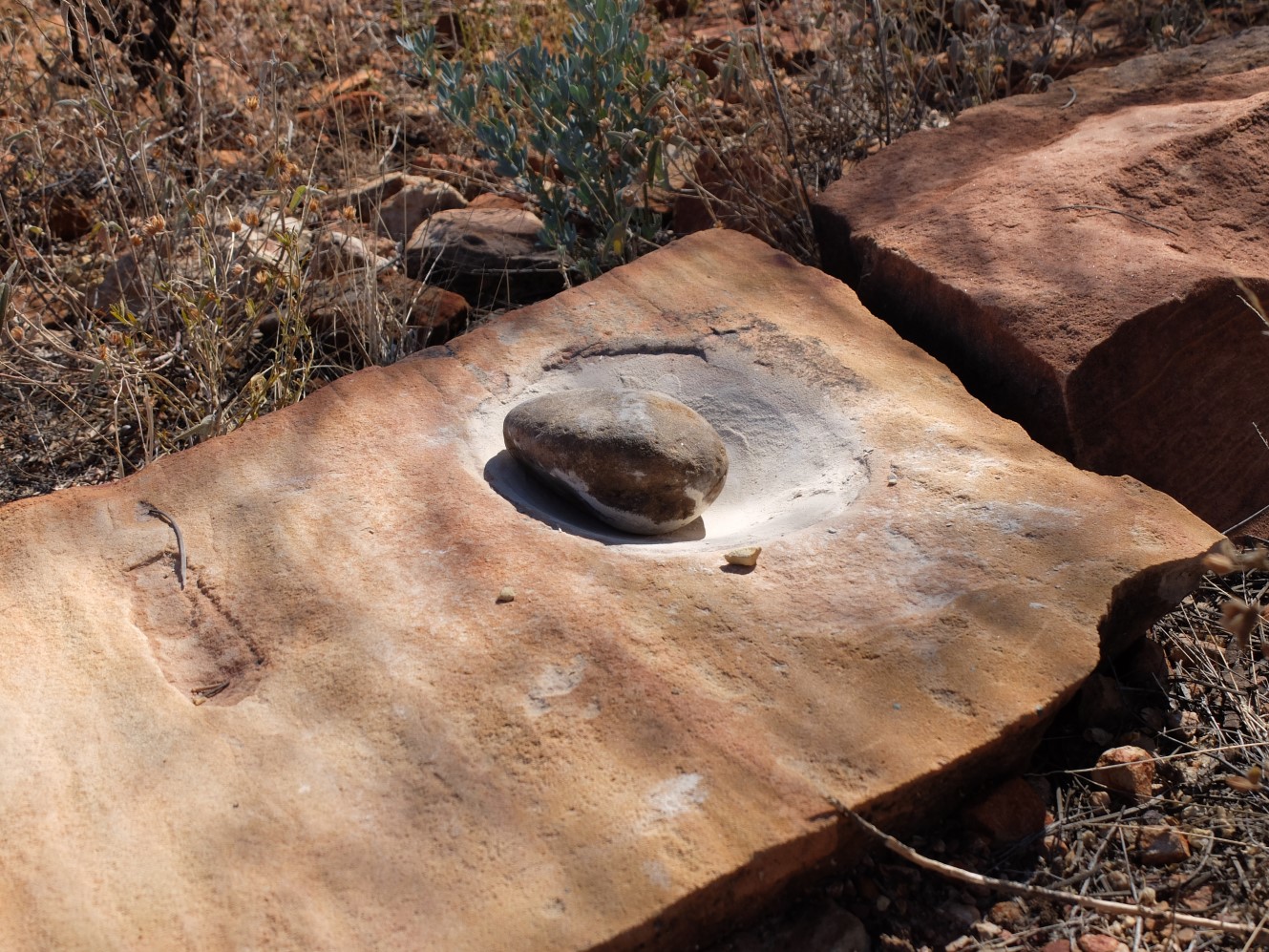
A grinding stone with grinder still in tact – April loved playing with this traditional tool!

Rainbow Valley at sunset, we decided against the unplanned camping trip!
The Nature Park was a chance to get up close to some of the amazing Kites, Falcons and Eagles that you often see in the sky or scavenging on the side of the road. All of them have adapted to the needs of the area in particular ways and it was fascinating to watch the behaviour of the birds, particularly when the Apex predator, the Wedge Tail Eagle, was out and about when he shouldn’t have been! We also spent time learning about the weapons and tools of the Aboriginal people – as they say these lands are the supermarket, hardware store, library and school for their generations. I loved hearing some of the stories about how they learned their “bushcraft.” My favourite was the process for testing an untried fruit or berry. As a new item was discovered (or a new way of cooking it developed) they would need someone to try the item to determine how it tasted and ultimately if it was poisonous or not. Step forward the elders of the tribe, the ones who had lived a good and full life and who would be sacrificed for the greater good if it turned out the new item was not fit for consumption. Simple, insightful and heroic this method obviously worked, but given the large number of plants and seeds that are not edible it would have taken a lot of sacrifice to get the knowledge levels to where they are today! When you hear about a nut that is poisonous until roasted in the fire and pealed you quickly realise that the passing down of information from generation to generation was an incredibly important part of survival.
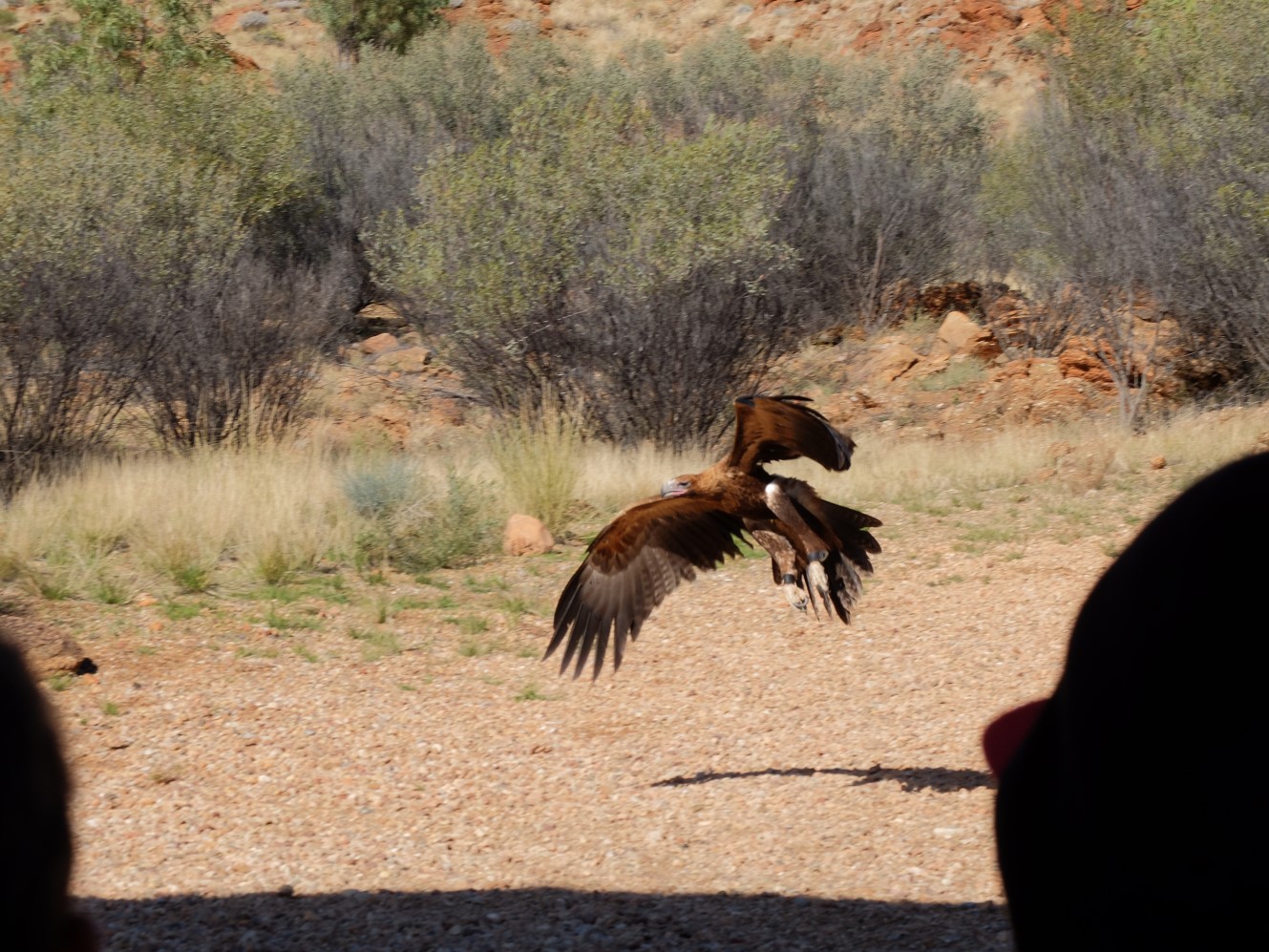
The Apex Predator is a fierce sight to see by the roadside or in flight!
Hayley’s mindfulness workshop was an amazing experience and Hayley emerged from it smiling and full of appreciation for life. In the next few days she shared some new practises, techniques and approaches that proved not only useful for relaxation, but also for having greater understanding, perspective and awareness of the present moment. I am sure that these will be useful not only through the trip, but for the rest of our lives…
While in Alice we had heard about a small area 70km north-east of town called Gemtree. This campsite ran fossicking tours of the local Garnet and Zircons fields which had come highly recommended for kids (and treasure seeking adults alike!). Our site had a huge fire pit and after chatting up the neighbours Des and Sharon (with their dog Charlotte), I headed off with the kids to do a spot of chopping and firewood collection. In exchange for borrowing Des’s axe I invited them over for marshmallows on the fire, but Sharon turned out to be an old hand at campfire cooking and in addition to our “desert” she whipped up a beautiful damper which we all quickly demolished as dinner! Sitting around the fire, sharing stories and eating fresh, warm bread with golden syrup and jam (not at the same time!) was a real treat!
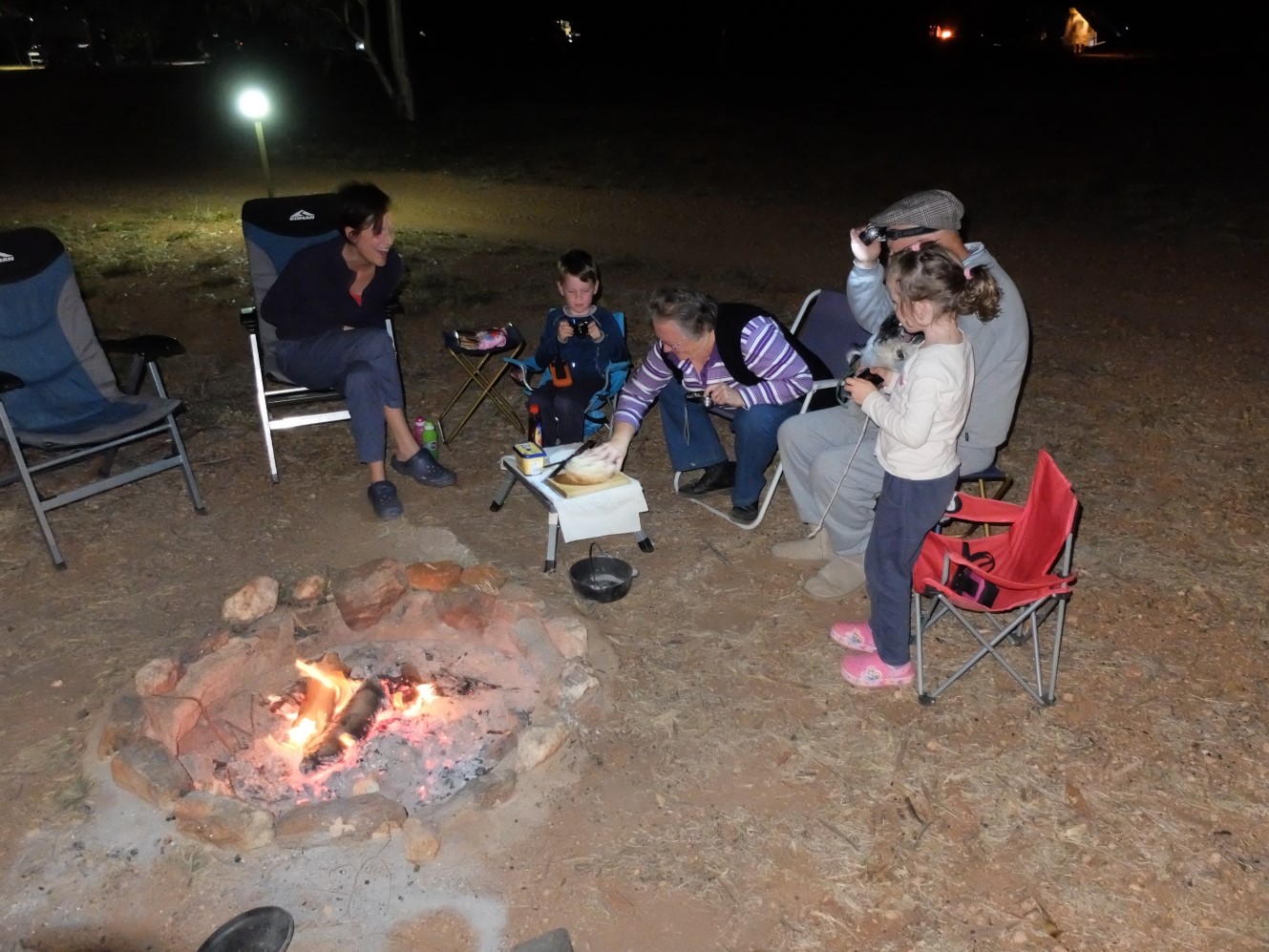
Dinner and desert all cooked on the open flame!

It tasted as good as it looks!
Fossicking has so many of the kids favourite things combined into one – digging, exploring, getting dirty and finding things – that it was bound to be a winner! After an enjoyable few hours finding mostly small Garnets (I was determined to stay until we had the “motherstone” but eventually was persuaded this is not all about me!) we headed back to the campsite, to have our Garnets assessed and then compare this to what others found (again that may have just been me). It was an enjoyable morning followed by a very similar end to the day before – some more firewood collection (this time even more so we could have a bigger fire!) followed by another story and baking session around the fire! The kids really enjoyed our time at Gemtree and I am glad that we made our way slightly off the beaten track to find it!
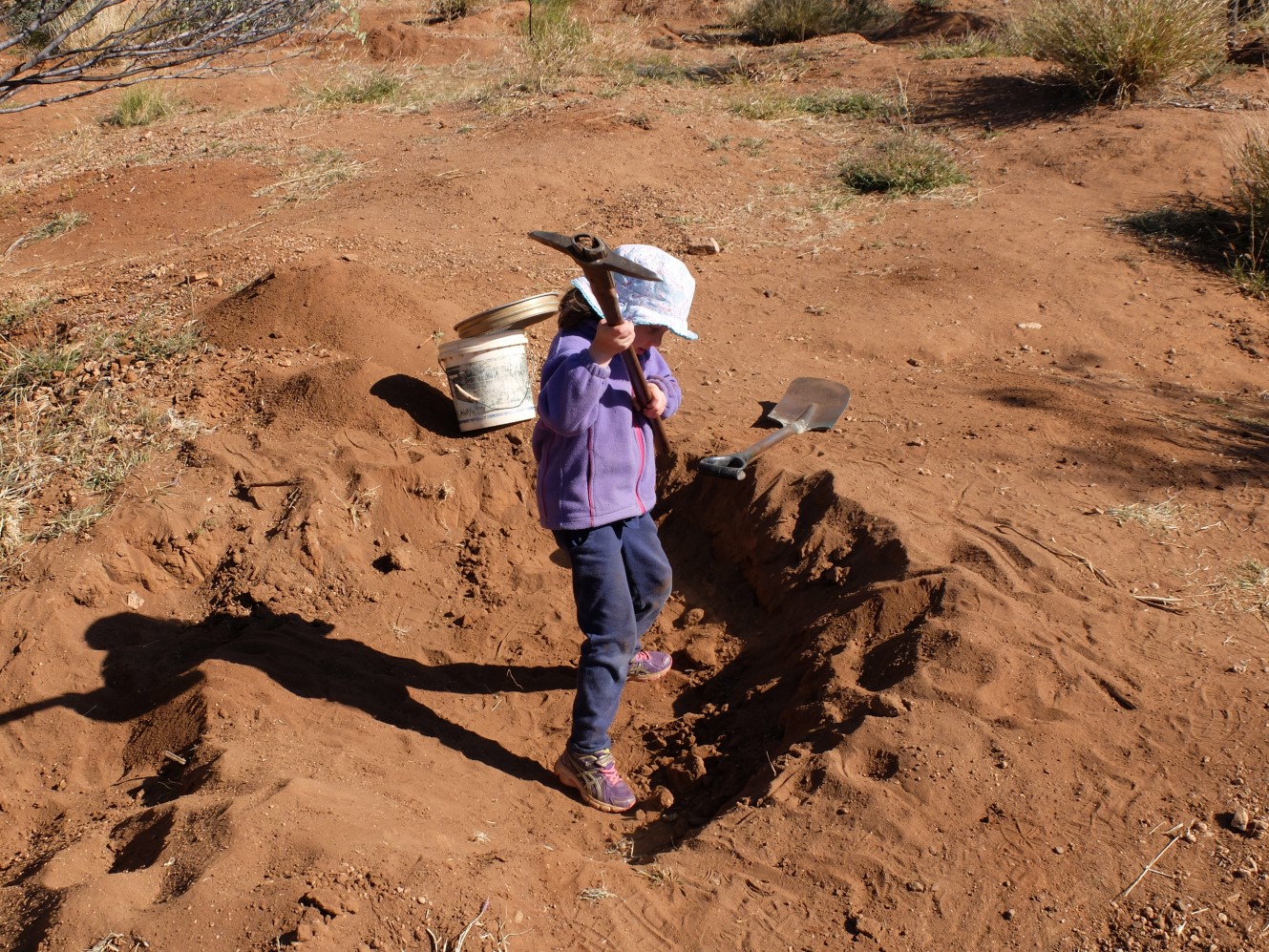
April and a pick, what could possibly go wrong!
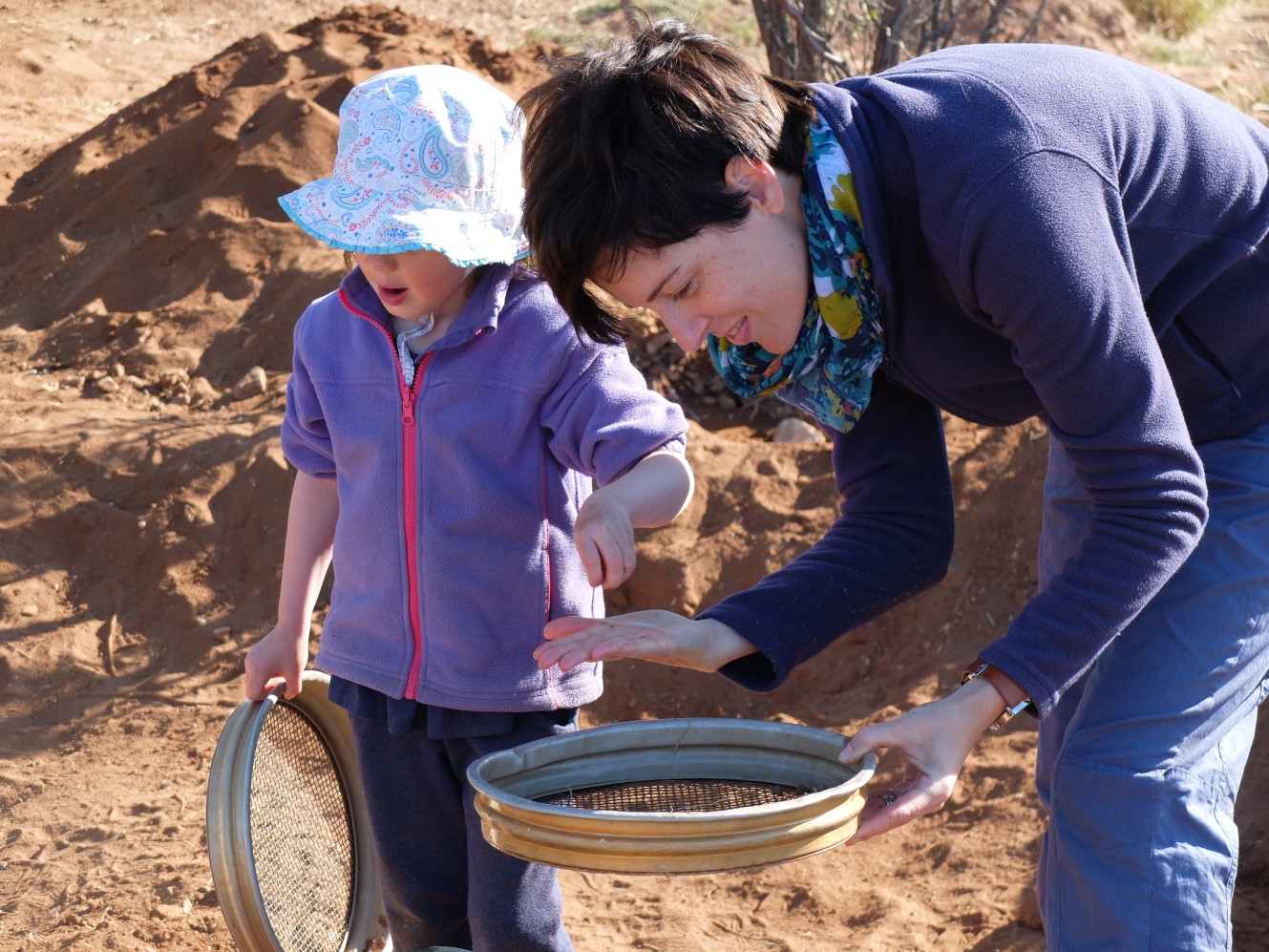
Dig, sift, wash, examine (all combined with a little bit of hope!)
The next day we followed Des out of the campsite and up the highway for a few hundred kilometres (for an old boy he sure could motor!), eventually saying goodbye as they turned off for the night and we pushed on, headed north towards the Devils Marbles and onward. We had thought about staying in the UFO capital of Wycliffe Well but our early start (and good time thanks to Des) meant we arrived early enough for a trip out to the “marbles” before assessing where we would stay for the night. In the end we spent some time exploring the amazing marbles before deciding to continue heading north to spend the night.

The Devils Marbles
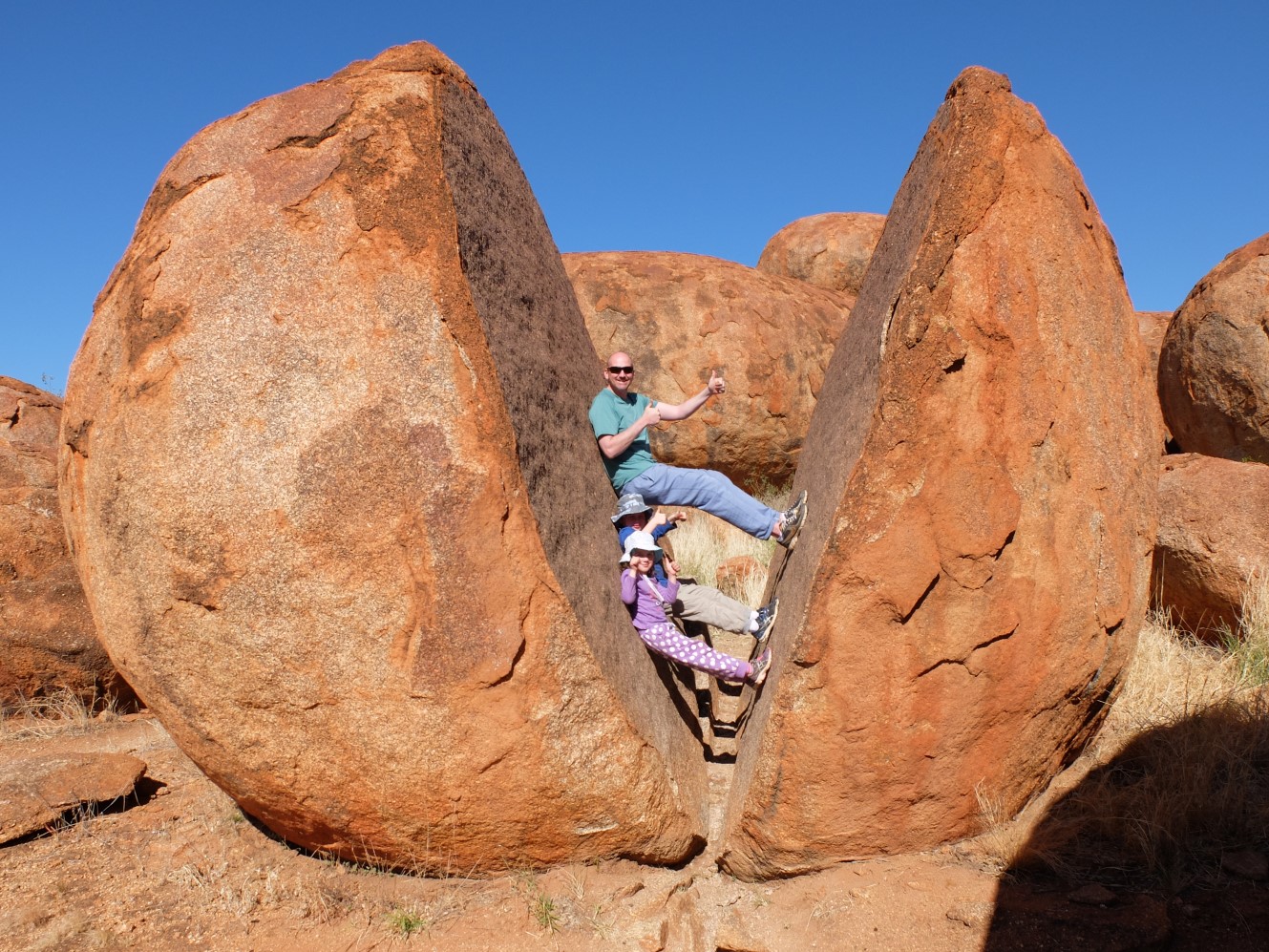
Hanging tough in the marbles, I seem to remember the glass ones doing this also!
The Devils Marbles are another one of those anomalies of popularity and circumstance. So easily reached from the main highway if you moved the road hundreds of kilometres away you would have a thriving tourist Mecca to rival Uluru and Kata Tjunta. As it is, a simple information hut and walking track guides you around the rock formations without so much as a ranger, camel tour or sunset dinner in sight! This is certainly not a bad thing but when you have some time on your hands (as we clearly do) it’s just another one of life’s little mysteries to ponder (although Hayley may make a case for it just being “me” rather than “we” that does the pondering!)…
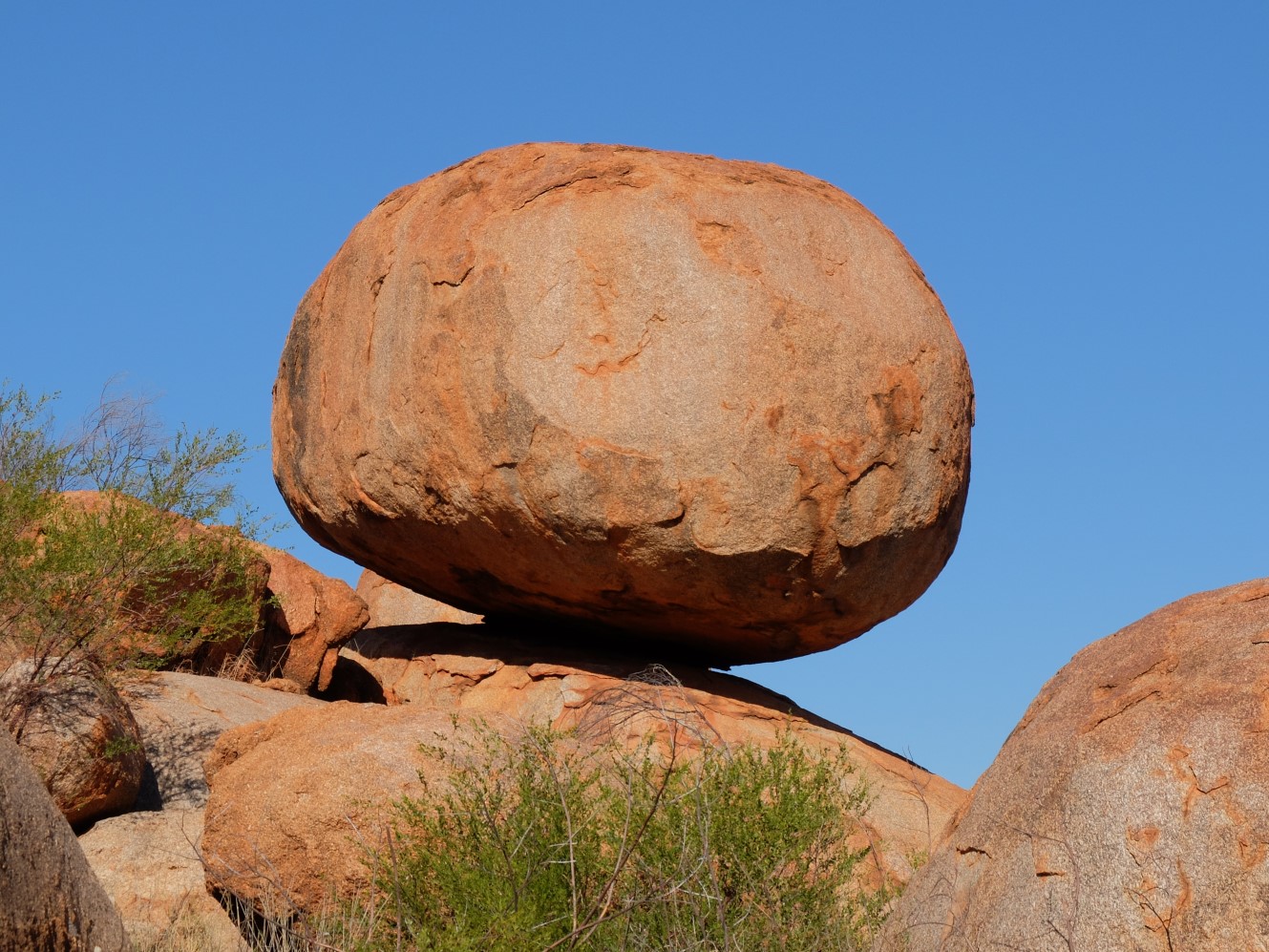
Something to ponder!
 Paul Family Road Trip 2015 (and 2016!)